

Did you know that approximately 70% of first-time business bank account applications from overseas founders are rejected by UAE banks? It’s a frustrating reality many entrepreneurs face after they’ve already invested time and capital into their company setup. You likely want to open business bank account in UAE for non-resident status to manage global transactions, but the strict compliance landscape can feel like an invisible wall.
We understand that the process feels opaque, especially with the enhanced due diligence now required by the Central Bank. This 2026 guide provides the exact steps, document requirements, and modern digital solutions you need to successfully approach UAE banking. We’ll explore which license types facilitate smoother approvals and how to meet economic substance rules without unnecessary overhead. By the end of this article, you’ll have a clear, actionable roadmap to secure the functional corporate account your business deserves.
Key Takeaways
- Navigate the strict 2026 AML and KYC regulations that contribute to high rejection rates for international applicants.
- Compare traditional and digital banking solutions to find the best fit for your specific balance requirements and transaction needs.
- Prepare a comprehensive application to open business bank account in UAE for non-resident entrepreneurs by gathering the correct corporate and personal documentation.
- Understand how specific trade licenses, like the E-Commerce License 0 Visa (starting at AED 4,000, subject to T&Cs), can simplify your path to a functional account.
- Learn how to work with expert navigators to streamline compliance procedures, keeping in mind that final approval always depends on the bank’s internal checks.
Understanding UAE Business Banking for Non-Residents in 2026
A non-resident business account isn’t just a financial tool; it’s the engine for your international operations. Within the UAE’s regulatory framework, this status applies to shareholders who don’t hold a residency visa but own a locally registered company. Banks are notoriously selective because they follow strict global standards for Anti-Money Laundering (AML) and Know Your Customer (KYC) protocols. This scrutiny isn’t meant to block your progress. It’s designed to protect the integrity of the Economy of the United Arab Emirates, which remains a top-tier global financial hub.
Many entrepreneurs believe they must rent a large physical office to satisfy bank managers. This is often a myth. While some traditional Tier-1 banks prefer physical premises, the rise of digital banking has changed the requirements. You can often qualify with a flexi-desk or a virtual office setup, provided you show “economic substance.” This means proving your business is active, has a clear purpose, and maintains legitimate records. If you want to open business bank account in UAE for non-resident status, focus on your business plan and transparency rather than square footage.
The Legal Reality of Non-Resident Banking
UAE law allows you to own 100% of your company in most jurisdictions. This autonomy is empowering, but it comes with specific banking responsibilities. Don’t confuse a personal savings account with a corporate entity. The Central Bank of the UAE mandates that corporate accounts undergo significantly more rigorous checks. You’ll need to provide a clear professional history and document the source of your investment funds. This ensures your business fits within the country’s transparent financial ecosystem.
Why 2026 is the Year of Digital Banking
The banking landscape shifted rapidly over the last year. Traditional branches often involve manual paperwork and waiting periods of four to eight weeks. Digital-first banks and neobanks have transformed this experience for international founders. These platforms offer remote onboarding through video KYC and digital document uploads. They prioritize speed and accessibility, making them the ideal choice for those who don’t plan to reside in the UAE full-time. Choosing a modern license type can often grant you immediate access to these streamlined banking partnerships.
Traditional vs. Digital Business Accounts: Choosing the Right Path
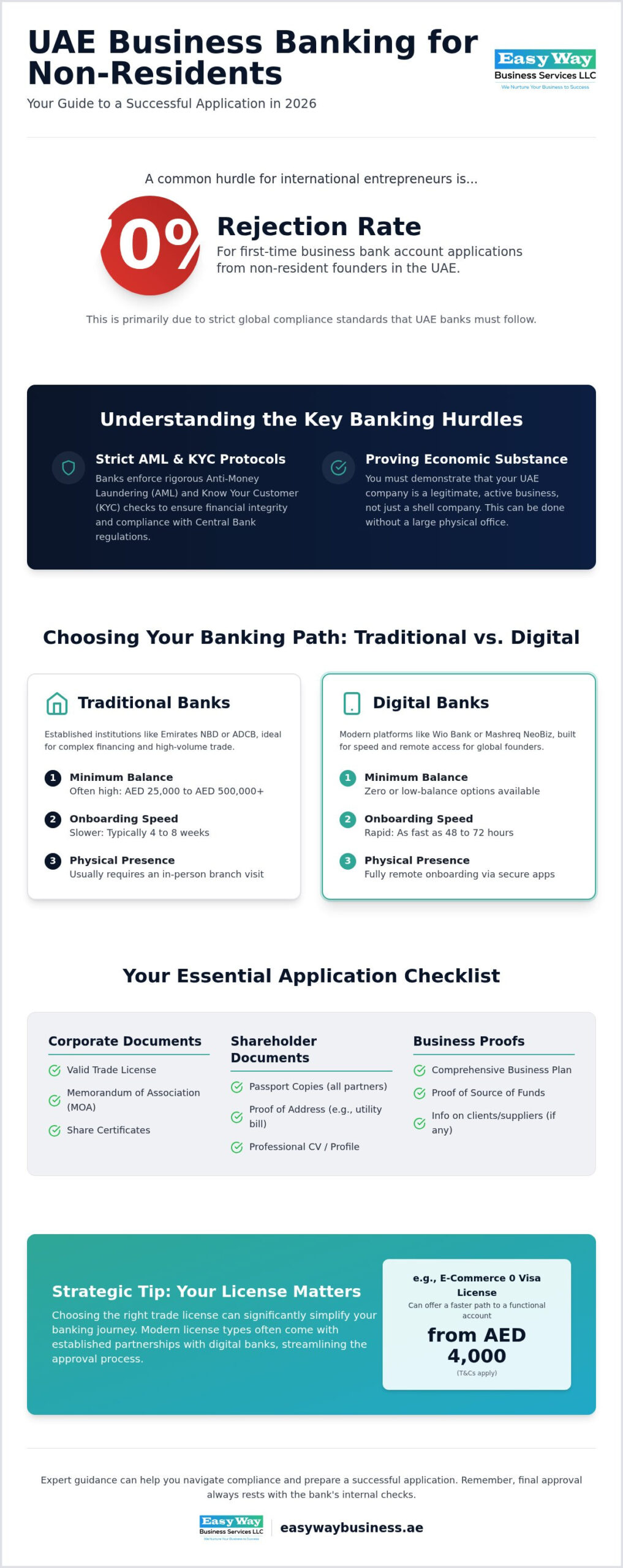
Selecting the right banking partner depends entirely on your business model and your long-term goals. Traditional institutions like Emirates NBD and ADCB are established pillars of the financial system. They offer a sense of permanence and a wide range of complex financial products. On the other hand, digital platforms like Wio Bank and Mashreq NeoBiz have redefined the experience for those who want to open business bank account in UAE for non-resident status. These neobanks prioritize speed and mobile-first accessibility, which is often the primary concern for international founders.
The UAE’s status as a global investment magnet is supported by World Bank data on the UAE, which highlights the country’s robust trade and economic growth. This growth has led to a diverse banking ecosystem where you can choose between high-touch relationship management and high-tech automated services. Before you apply, consider these key differences in requirements:
- Minimum Balance: Traditional banks often require average monthly balances ranging from AED 25,000 to over AED 500,000. Digital banks frequently offer zero-balance or low-balance accounts for a fixed monthly fee.
- Onboarding Speed: Digital platforms can sometimes approve accounts in 48 to 72 hours. Traditional banks typically take four to eight weeks due to manual compliance reviews.
- Physical Presence: Most traditional banks require at least one signatory to visit a branch in person. Many digital banks allow for remote verification through secure mobile apps.
When to Choose a Traditional Brick-and-Mortar Bank
If your business involves high-volume physical trading, complex corporate financing, or the frequent use of Letters of Credit (LC), a traditional bank is usually necessary. These institutions provide a dedicated relationship manager who can help navigate complex international trade regulations. However, be prepared for a more substantial initial deposit and a requirement for a more permanent physical presence in the UAE.
The Benefits of Digital Business Banking
Digital accounts are the gold standard for e-commerce, consulting, and software-as-a-service (SaaS) companies. They offer seamless integration with international payment gateways and provide transparent transaction fees for global transfers. The KYC process is streamlined, often requiring only a few digital document uploads. If you aren’t sure which path fits your specific activity, it’s helpful to request a tailored consultation to review your options.
The Role of Your UAE Trade License in Account Approval
Think of your trade license as more than just a legal permit; it’s the primary document banks use to measure your company’s risk profile. When you aim to open business bank account in UAE for non-resident shareholders, the bank’s compliance team looks at your license to see if your activities align with their risk appetite. Banks are naturally cautious. They want to ensure every dirham flowing through their system is legitimate. If your license covers vague or high-risk activities like general trading or complex brokerage services, you’ll face much tougher questions during the vetting process.
A clear business profile is your best defense against rejection. Banks don’t just look at the paper; they look at the logic behind your business. They’ll check if your chosen activities match your professional background and your stated goals. At EasyWay, we help you select the jurisdiction and activity list that offers the highest probability of banking success. We’ve seen that a well-prepared application, backed by a license that makes sense for your industry, significantly reduces the time spent in compliance limbo.
Free Zone vs. Mainland: Impact on Banking
The choice between a Free Zone and a Mainland setup isn’t just about taxes; it’s about banking accessibility. Mainland companies often have an easier time with traditional Tier-1 banks because they are governed by the Department of Economy and Tourism (DET). These businesses usually have a physical office presence, which traditional bankers still value. If your goal is to secure high-volume credit lines or letters of credit, Mainland Company Formation is often the strategic choice. Conversely, many Free Zones have established partnerships with digital banking platforms. These zones have already done the heavy lifting by vetting their members, which allows for a smoother experience during the digital onboarding process.
Selecting the Right Business Activity
To improve your approval odds, focus on transparent, low-risk business activities. Categories like IT consultancy, digital marketing, and software development are favorites for both traditional and digital banks. These services are easy to explain and verify. Our E-Commerce License 0 Visa package is specifically designed for founders who want a streamlined start. Priced at AED 4,000 (subject to terms and conditions), this license type is highly regarded by digital banks because the business model is straightforward. Beyond the license, your business profile matters. Ensure your website is professional and your business plan clearly outlines your expected suppliers and clients. Banks want to see a clear map of where your money comes from and where it’s going.
Step-by-Step Guide to Applying for Your UAE Business Account
Some marketing platforms promise you can open an account in minutes. Don’t be misled by these claims. For international founders, the process is thorough and requires a methodical approach to documentation. If you want to open business bank account in UAE for non-resident status, you must prove your business is legitimate and your funds are transparent. Preparation is the only way to overcome the high rejection rates that stall many entrepreneurs.
The application journey begins once your trade license is issued. You’ll move through a series of compliance checks designed to satisfy both local and international regulations. While the specific requirements vary between institutions, the core process remains consistent across the UAE banking sector. Approvals always depend on the bank’s internal compliance checks, but following a structured path significantly improves your chances.
Essential Documentation Checklist
Gathering the right paperwork is half the battle. Banks prioritize clarity and consistency above all else. If your documents are incomplete or poorly presented, your application will likely stall in the initial review phase. Ensure you have the following ready:
- Passport copies for all shareholders and authorized signatories.
- UAE entry stamp or visa copy (if applicable).
- Proof of residential address from your home country, such as a recent utility bill.
- Your UAE Trade License and Certificate of Incorporation.
- Memorandum and Articles of Association (MOA/AOA).
- 6-month personal bank statements from the shareholders’ home country.
- A detailed business plan outlining expected turnover and key suppliers or customers.
Navigating the KYC and AML Interview
The Know Your Customer (KYC) interview is the final major hurdle. For digital banks, this is often a secure video call; traditional banks may require an in-person meeting at a branch. Bankers will ask specific questions about your source of wealth. They want to understand exactly how you generated your initial capital. Be ready to discuss your business model and your professional background with confidence.
Consistency across your digital footprint is vital. Your company website and social media presence should reflect the activities listed on your trade license. Discrepancies between your application and your online profile often lead to immediate rejection. To boost your credibility, consider securing a local UAE phone number and a registered business address. These details signal that your business has genuine substance in the region. Once your submission is complete, the compliance team will conduct a final review before issuing your IBAN. If you want to avoid common filing errors, contact EasyWay today to ensure your documentation meets every bank requirement.
Strategic Support: How EasyWay Business Services Simplifies Your Setup
Establishing a presence in a new market is a bold move. It shouldn’t be stalled by administrative hurdles or banking rejections. EasyWay Business Services acts as your seasoned navigator through the local regulatory landscape. We provide end-to-end support that bridges the gap between getting your trade license and securing your corporate IBAN. Our goal is to remove the complexity so you can focus on scaling your business.
If you want to open business bank account in UAE for non-resident status, our E-Commerce License 0 Visa package is an ideal starting point. At AED 4,000 (subject to terms and conditions), this package offers a cost-effective way to enter the market without the immediate need for residency. Every promotional package we offer includes digital business bank account assistance. We don’t just hand you a license and walk away. We guide you through the digital onboarding process to ensure your application is professional and compliant.
Our multilingual team speaks over 10 languages. This is crucial when dealing with document legalization and translation requirements. We handle the technical details that often trip up international founders, ensuring your paperwork is ready for bank scrutiny from day one. By managing these logistics, we reduce the anxiety often associated with starting a venture in a foreign market.
A-to-Z Assistance from Incorporation to Banking
We manage the government liaison and paperwork on your behalf. This saves you time and reduces the risk of costly filing errors. With partnerships across more than 20 Free Zone authorities, including SHAMS, we help you find the most bank-friendly jurisdiction for your specific activity. You can explore our business setup offers to see which configuration aligns with your budget and operational needs.
Why Experience Matters in UAE Banking
Success in the UAE banking sector often comes down to preparation and relationships. We’ve formed more than 2,000 companies in the region. This experience allows us to anticipate compliance questions before they’re even asked. We maintain established relationships with leading digital providers like Wio Bank to help facilitate a smoother onboarding experience. While final approval always rests with the bank’s compliance department, our expertise ensures your case is presented in the best possible light. If you’re ready to start, contact us today for a tailored recommendation based on your business goals.
Secure Your Financial Future in the UAE
Opening a corporate account as an international founder is a strategic milestone that requires the right preparation. You’ve learned that the landscape in 2026 favors those who choose bank-friendly jurisdictions and maintain absolute transparency in their business profiles. Whether you opt for a traditional institution or a modern digital platform, your success depends on meeting strict compliance standards and providing accurate documentation. It’s entirely possible to open business bank account in UAE for non-resident status when you have a clear roadmap and the right support.
EasyWay Business Services is here to ensure your application stands the best chance of success. With experience forming over 2,000 companies and partnerships with more than 20 Free Zone authorities, we understand exactly what local banks require. Our multilingual experts provide the guidance you need to navigate complex regulations with confidence. Don’t let administrative hurdles slow your expansion. Start your UAE business journey with EasyWay Business Services today. We’re ready to help you turn your professional dreams into a logistical reality.
Frequently Asked Questions
Can a non-resident open a business bank account in the UAE?
Yes, it is entirely legal. You can open business bank account in UAE for non-resident shareholders of a locally registered company. Banks focus on the legitimacy of the company and the source of funds. You don’t need to live in the UAE to own a business or a corporate account. However, you must provide extensive documentation to satisfy the bank’s compliance team regarding your professional background and business intentions.
How much does it cost to open a corporate bank account in Dubai?
Banks generally don’t charge a direct opening fee for the account itself, but you should budget for related costs. These include trade license fees, document attestation, and potentially a monthly service fee if you don’t maintain a minimum balance. Some digital platforms charge a flat monthly subscription instead of requiring a large deposit. It’s best to request a current quotation for setup packages to understand the total investment required.
What is the minimum balance required for a UAE business account?
Minimum balance requirements vary significantly depending on the bank and account type. Traditional banks often require an average monthly balance between AED 25,000 and AED 500,000. For international businesses, some Tier-1 banks might expect balances toward the higher end of that range. Conversely, many digital banks offer accounts with low or zero balance requirements, making them a popular choice for startups and smaller non-resident enterprises.
How long does the bank account opening process take for foreigners?
The timeline depends largely on the type of bank you choose. Digital banks can often process and approve applications in as little as 48 to 72 hours if all documentation is in order. Traditional brick-and-mortar banks typically take much longer, often ranging from four to eight weeks. This extended period is due to rigorous manual compliance checks and the high volume of international applications they process.
Do I need a residency visa to open a business bank account?
No, a residency visa isn’t strictly mandatory, but it does make the process easier. Having at least one authorized signatory with a UAE residence visa and an Emirates ID significantly improves your chances of approval with traditional banks. If you prefer to remain a non-resident, digital banks are often more accommodating, though they still require a valid UAE trade license and proof of your company’s economic substance.
Can I open a UAE business bank account online from my home country?
You can initiate the process online, but final verification often requires your physical presence. Most traditional banks require you to visit a branch to sign documents in front of a bank officer. Some modern digital banks allow for remote onboarding using video KYC technology. This means you might be able to complete the verification via a secure mobile app without flying to the UAE, depending on the bank’s current policies.
What are the main reasons for bank account application rejection?
Rejections often stem from a lack of transparency or documentation errors. Common reasons include:
- Inconsistent information between your business plan and website.
- Inability to clearly prove your source of wealth.
- Selecting high-risk business activities.
- Lack of a clear economic presence in the UAE.
- Failure to pass internal AML risk assessments.
Approvals always depend on the bank’s compliance checks, so thorough preparation is vital.
Which UAE bank is best for non-resident startups?
There isn’t a single best bank as it depends on your specific business activity and turnover goals. Digital platforms like Wio Bank and Mashreq NeoBiz are currently very popular for non-resident startups due to their fast onboarding and low balance requirements. For larger companies with complex trade finance needs, traditional banks like Emirates NBD or ADCB might be better suited. We recommend discussing your business model with an expert to find the right fit.