

A trading company typically buys a defined range of products, holds stock or arranges delivery, and sells those goods to businesses or end customers. In the United Arab Emirates, importers and wholesalers connect overseas suppliers with local buyers and manage the movement of products through the supply chain.
How you source and sell goods affects costs, operations, and customer relationships. The right model depends on whether you import products, supply shops in bulk, or trade across a broader market.
This guide explains how trading companies earn revenue, how importers and wholesalers serve customers, and how common trading models differ. It also explains how a trading activity relates to setting up a business in the UAE, helping you assess the model before choosing a structure.
Key Takeaways
- Understand how trading businesses earn revenue through product selection, sourcing, stock management, and sales to business or end customers.
- Compare importers, wholesalers, specialist traders, and broad-range trading businesses to identify the model that matches your customers.
- Map your UAE setup around the products you plan to trade, your sales channels, and the business activities you intend to carry out.
- Learn why licensing and approval needs depend on your chosen activity and business setup.
- See which setup costs to consider and how EasyWay Business Services’ licensing options relate to different business plans.
How do trading companies make money?
A trading company earns revenue by selling products for more than it pays to source and deliver them. For example, a UAE wholesaler might buy restaurant equipment from a supplier and resell it to cafés. The difference between the sale price and purchase cost is gross profit before operating expenses.
The business model starts with choosing products. A company focused on a defined category, such as electrical components or packaged foods, can target buyers with recurring needs. It assesses supplier terms, demand, delivery requirements, and the price customers will accept. A focused range can also make stock planning and sales expertise easier to manage.
Importers and wholesalers often serve a wider market than neighborhood shops. A wholesaler supplying retailers across the UAE can generate revenue from repeat bulk orders, while a local shop usually sells smaller quantities directly to nearby customers. Larger orders may mean more sales per transaction, but they also call for careful stock and cash-flow planning.
The basic calculation is simple: sales revenue minus product and delivery costs equals gross profit. Net profit is what remains after other expenses, such as premises, staff, storage, marketing, and administration. A product may sell well but contribute little if sourcing, handling, or storage costs consume too much of its selling price.
For example, a UAE distributor might sell replacement parts to repair businesses across the country. It earns from reselling each part, while reliable availability and accurate product selection can encourage repeat orders. This is an illustration, not a forecast: actual results depend on supplier prices, customer demand, order size, and operating costs.
Some businesses also earn through distribution arrangements or related services, depending on their contracts and operating model. Keep the main revenue source clear: identify what customers pay for, then track the cost of providing it. A trader selling stock earns through resale; a business arranging transactions for others may instead charge a service fee.
- Source carefully: Compare supplier terms and product quality before committing to stock.
- Set selling prices: Account for purchase, delivery, storage, and operating costs.
- Manage inventory: Balance product availability against the cash tied up in unsold goods.
- Build repeat sales: Focus on reliable supply and products buyers need regularly.
In practice, profitability depends on how purchasing, pricing, and stock decisions work together. A UAE importer handling bulky goods, for example, needs to include storage and delivery in its cost calculations. Reviewing figures by product helps the owner see which lines support the business and which may need a different supplier, price, or sales approach.
What are the main types of trading companies?
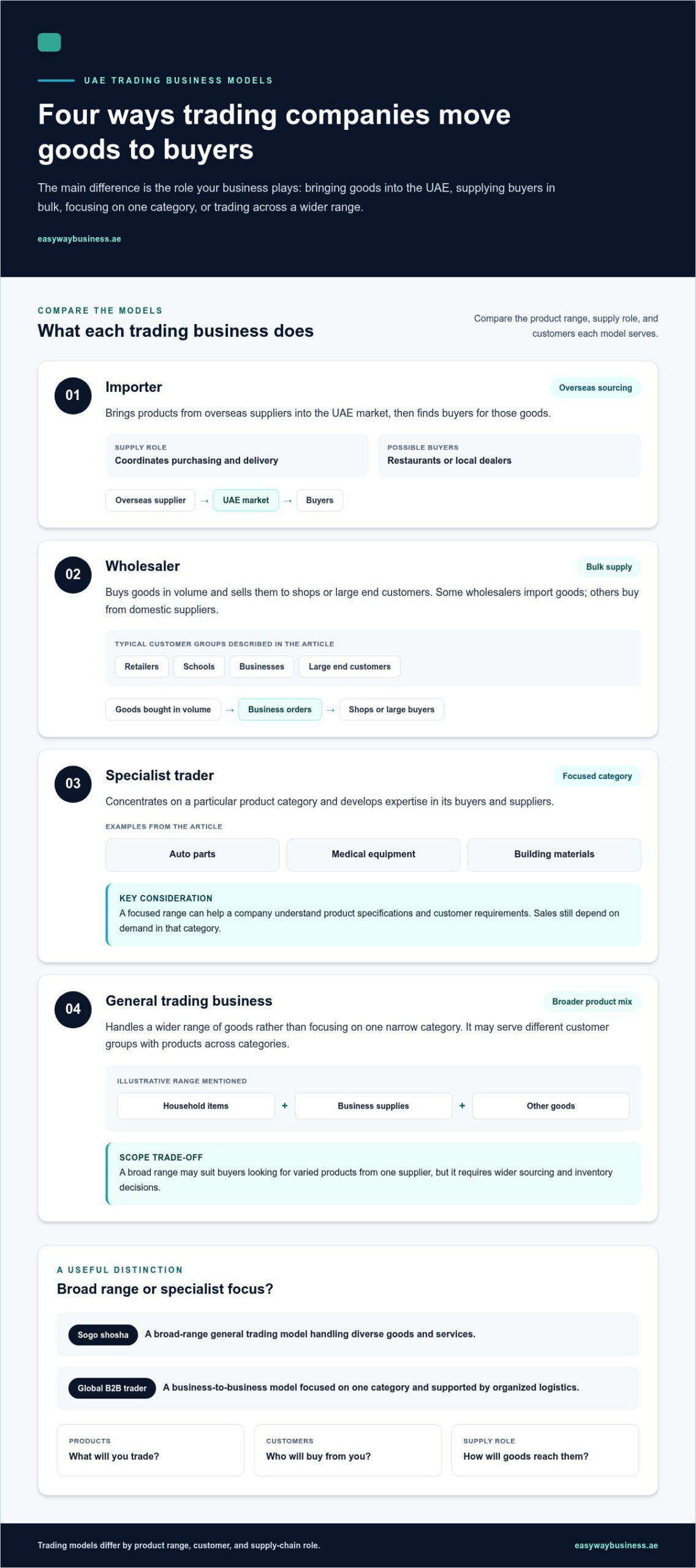
Trading businesses differ by the products they handle, their customers, and their supply-chain role. Across the UAE, one firm may import equipment for business buyers, while another supplies everyday goods to retailers. These distinctions shape how each company sources products, manages stock, and reaches customers. They also help owners describe their operating model clearly when planning a new venture.
Importers bring products from overseas suppliers into the UAE market. A business importing commercial kitchen equipment, for example, may sell directly to restaurants or supply local dealers. It coordinates purchasing and delivery, then finds buyers for the goods. Its customer base can span the country rather than focus on one neighborhood.
Wholesalers buy goods in volume and sell them to shops or large end customers. A wholesaler of office supplies might serve retailers, schools, and businesses across the UAE. Unlike a shop focused on walk-in buyers, it generally relies on business orders and product availability. Some wholesalers import their goods; others buy from domestic suppliers.
Specialist traders focus on a particular product category and develop expertise in its buyers and suppliers. Examples include businesses dealing in auto parts, medical equipment, or building materials. A focused range can help a company understand product specifications and customer requirements, but sales also depend on demand in that category.
General trading businesses handle a wider range of goods instead of focusing on one narrow category. They may serve different customer groups with products such as household items and business supplies. This broad scope may suit buyers seeking varied products from one supplier, but it also requires wider sourcing and inventory decisions.
The term sogo shosha describes a broad-range general trading model that handles diverse goods and services. Another common model is a global business-to-business trader focused on one category and supported by organized logistics. The key difference is scope: one spans sectors, while the other builds around specialist products and supply operations.
Compare these models by identifying the role your business will perform:
- Importing: Source goods internationally and sell them in the UAE.
- Wholesaling: Supply retailers or large buyers with products in bulk.
- Specialist trading: Focus on a defined category and its customer needs.
- General trading: Offer a broader mix of products across categories.
The right description depends on what you plan to sell and who will buy it. A business supplying spare parts to repair shops differs from a retailer selling directly to consumers. Before settling on a model, map your products, customer types, and sourcing role. You can discuss your UAE business setup options as you define that plan.
Importers and wholesalers typically hold stock and deliver products to shops or large end customers. Their role combines sourcing or bulk purchasing with keeping goods available for onward supply.
The term “trading company” mainly refers today to global B2B traders that specialize in one goods category and have a strong logistics organization. The label can point to a focused international operation, even though general trading remains a distinct model for businesses offering a broader range of goods. Describing the goods, customer type, and supply-chain role helps distinguish these operating models.
How do I start a trading company in the UAE?
Start with the business you plan to operate, not a generic company label. An importer of kitchen equipment needs to describe its products, customers, and sales channels clearly. Those details help determine the appropriate business activity and setup route. An online trading company may need a different activity description from a wholesaler supplying shops directly.
Use this planning sequence before preparing an application:
- Define the product range. List the goods you plan to sell, such as spare parts, food products, or office supplies. A clear range helps avoid choosing an activity that does not match the actual business.
- Identify your customers. Decide whether you will sell to UAE retailers, large business buyers, or consumers. For example, supplying supermarkets differs from selling through an online storefront.
- Choose the operating location and setup route. Compare a mainland setup with a free zone setup against your intended customers, sales model, and operational needs. The choice shapes the company formation path and activities to consider.
- Prepare the proposed company details. Organize the intended business name, ownership information, activity description, and contact details. The relevant authority reviews the application through its process and requirements.
- Clarify the licensing process. Submit the required application information and respond to authority requests. Ask the relevant authority which licence or approvals apply to your activity and when the business may begin operating.
Keep the activity description practical. If you plan to import and resell car parts, describe that trading purpose rather than relying on a broad phrase such as “general business.” A precise description gives the authority a clearer basis for reviewing the application and helps align the licence with the actual operation.
Next, plan how the company will operate after formation. A wholesaler supplying retailers needs a sourcing plan, inventory process, delivery arrangements, and a way to manage business orders. An online seller needs product listings, payment handling, and order fulfilment. These decisions help you choose a model that works in practice.
Finally, keep records for each stage. Store supplier details, product descriptions, customer segments, and the selected activity in one working file. If the business adds product categories or changes its sales model, review whether the activity description still reflects its operations. For a trading company, aligning the licence activity with the actual business helps keep planning and application details consistent.
What licences and approvals does a UAE goods trader need?
A UAE trading company needs a commercial licence that reflects its intended business activity. The licence is linked to the chosen setup route, such as a mainland or free zone company. For example, a business selling office furniture should describe its actual trading activity rather than rely on a vague company label.
A licence and additional approvals serve different purposes. The licence records the business activities the company is set up to conduct. Other approvals may apply to particular products or operations, depending on what the company trades and how it operates. A seller of ordinary household goods should not assume its approval needs are the same as those of a business handling regulated products.
Start by matching the proposed activity to the actual business model. An importer selling spare parts to repair shops, an online seller of accessories, and a wholesaler supplying retailers may need different activity descriptions. When explaining the plan, include the product category, sales channel, and customer type. Clear details help identify what the application needs to cover for the proposed trading company.
Next, choose the jurisdiction and licensing route. A mainland commercial licence and a free zone licence are distinct setup options. The right fit depends on the intended operations, market, and business structure. Consider where the company plans to operate, who it will sell to, and whether it expects to trade through a shop, online channel, or business-to-business supply arrangement.
Before filing, organize the application information around these points:
- Business activity: Describe the goods and the role the company performs, such as importing, wholesaling, or retailing.
- Product category: Identify the products clearly, especially where their handling or use may involve additional approvals.
- Sales model: Explain whether sales will be online, through a physical location, or directly to business buyers.
- Setup route: Align the selected mainland or free zone structure with the proposed activity.
- Approval needs: Identify any product or operational approvals connected to the specific goods and activities.
For example, a business planning online sales of consumer accessories should ensure its activity description reflects online trading. If it later adds another product category, it should review whether the existing licence and approvals cover the change before proceeding. The same review applies when a wholesaler expands into direct retail sales.
Keep the licence, activity description, and approval records together as the business develops. This gives the owner a clear reference when adding products, changing sales channels, or updating the operating plan. A trading company’s approval needs depend on its goods and activities, so consult the relevant authority about its specific circumstances.
What Are the Setup Costs and Fees for a UAE Trading Business?
There is no single setup cost for every UAE trading business. Mainland and free zone companies can have different cost components. The selected activity, premises, visa needs, and product range also shape the budget. A business importing spare parts, for example, may need different operating resources from an online seller without a stockroom.
The total price depends on the case and is provided after a quote request; key factors include jurisdiction, activity, premises, visa requirements, and any product-specific approvals.
Separate formation expenses from the money needed to run the business. The first category covers establishing and licensing the company. The second covers ongoing operations, such as buying stock, storing goods, and delivering orders. This distinction helps a trading company avoid treating its licence expense as the full startup budget.
Build a planning sheet with the cost categories relevant to your business model:
- Company setup and licensing: Include charges linked to the chosen jurisdiction, business activity, and application.
- Premises: Consider the office, shop, warehouse, or other space your operating plan uses.
- Visa needs: Include visa-related costs if your ownership or staffing plan requires them.
- Product approvals: Allow for relevant requirements tied to the goods you intend to trade.
- Operating funds: Budget separately for stock purchases, storage, transport, and customer fulfilment.
For example, a wholesaler supplying building materials may need to budget for inventory and storage alongside company formation. An online seller of lightweight accessories may have a different cost mix, with more emphasis on product sourcing, packaging, and delivery. These examples show why the business activity alone cannot determine the full budget for a trading company.
Ask for a breakdown that separates one-time setup items from recurring expenses. Identify which items depend on your chosen jurisdiction or activity and which relate to daily operations. A warehouse-based importer should review premises and inventory assumptions. An online seller should map fulfilment and payment operations. Comparing these categories makes alternative budgets easier to assess.
Leave room in your plan for changes. A business that adds product lines, staff, or a physical sales location may face different costs from its initial model. Review the budget whenever the operating plan changes, especially before committing to additional premises or stock. For a UAE-specific estimate based on your proposed activity and setup, request a tailored setup quotation.
EasyWay Business Services: E-Commerce License 0 Visa
EasyWay Business Services helps you understand UAE company formation options and navigate the required setup procedures. If you’re planning online sales, the E-Commerce License 0 Visa may suit your business model. Other options include a Freezone license with one visa, a Freezone license with Two visa, and a Mainland commercial License.
The right route depends on your intended activity, sales model, and business requirements. Share those details when discussing your setup so you can understand which option aligns with your plans. Requirements and approvals may vary according to the relevant authority and your circumstances.
Contact EasyWay Business Services to discuss your UAE business setup.
Turn your trading plan into a clear next step
Plan your setup around how you intend to operate, not just the products you want to sell. Consider who will manage the business, whether sales will happen online or through direct trade, and what company structure supports those plans. A clear outline makes it easier to discuss suitable UAE formation options.
EasyWay Business Services offers an E-Commerce License 0 Visa, a Freezone license with one visa, and a Freezone license with Two visa. These options can help you compare possible routes for a trading company based on your business model and needs. The appropriate choice depends on your circumstances and the relevant authority’s requirements.
Prepare a short description of your planned activity, sales channel, and setup priorities before discussing your options. Contact EasyWay Business Services to discuss your UAE business setup and take your next step with a clearer plan.
Frequently Asked Questions
What is a trading company and what services does it provide?
A trading company buys and sells goods, often focusing on a particular product range. It may source products from suppliers, hold stock, and deliver orders to retailers or larger buyers. For example, a UAE business supplying restaurant equipment could purchase items from manufacturers and distribute them to cafés. Its role is to connect suppliers with customers through sourcing, inventory management, and sales, rather than necessarily manufacturing the goods itself.
How do I choose reliable suppliers and customers for a trading company?
Compare supplier terms and product quality, and assess demand, delivery requirements, and costs before committing to stock. Identify customers’ recurring needs and encourage repeat sales through reliable supply and suitable product selection.
What are the key risks and legal obligations for trading companies?
Stock and cash-flow planning are key considerations: unsold inventory and sourcing, handling, or storage costs can reduce profit. Keep the activity description aligned with the actual business, and confirm the required licence and approvals with the relevant authority.