

The best Free Zone for your business may not be the one with the most familiar name. For UAE business setup for foreigners, the right choice depends on your permitted activities, intended company structure and practical requirements, including sponsorship and banking.
It’s understandable to focus first on the Free Zone and its licence. But the setup needs to fit how you plan to operate. Opening a business bank account is a separate process, and the bank makes its own decision.
This guide explains how to compare Free Zone, mainland and other company-formation options, match activities to a licence and consider ownership, visas and banking. To get a tailored recommendation, be ready to share your intended business activity, preferred jurisdiction, number of shareholders, required visas, nationality and residency status, and desired timeline.
Key Takeaways
- Match the Free Zone to your business activities and operating plans, not just its location or name.
- Check which licence covers your intended activities and whether your business may need additional approvals.
- Understand how ownership and sponsorship requirements can depend on your chosen structure and activity.
- Compare free zone, mainland and offshore structures by where and how you plan to do business.
- Prepare for a separate bank review: company setup does not guarantee that a bank will approve an account.
Business licences and permitted activities
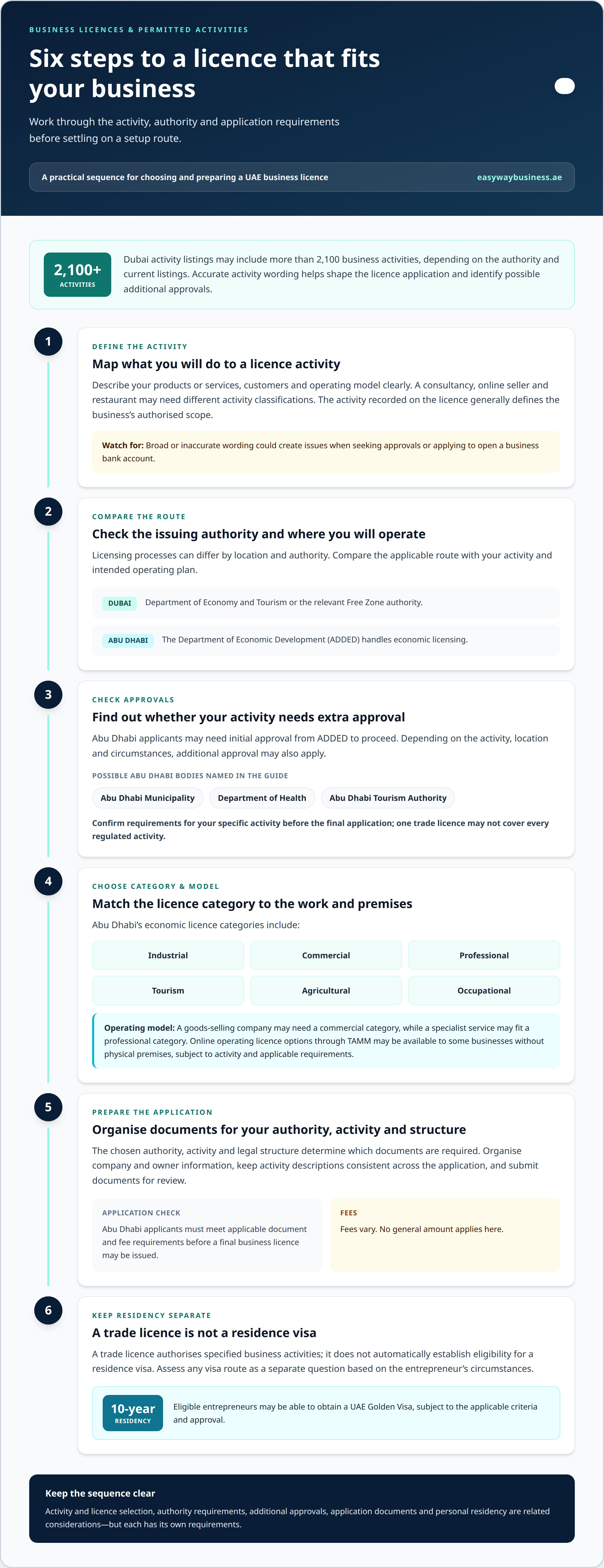
Choose a licence that reflects the work your business will perform. Dubai’s available activity listings may include more than 2,100 business activities, depending on the authority and current listings. Choosing an accurate activity can help shape your licence application and identify any further approvals that may apply.
- Map your planned activities to a licence. Ask a UAE setup professional to describe your products, services, customers and operating model clearly. A consultancy, online seller and restaurant may need different activity classifications. The activity recorded on the licence generally defines the business’s authorised scope, so broad or inaccurate wording could create issues when you apply for approvals or open a bank account.
- Compare the issuing authority and location. Dubai’s Department of Economy and Tourism and the relevant Free Zone authority have licensing processes that may differ. In Abu Dhabi, the Department of Economic Development (ADDED) handles economic licensing. The suitable route depends on where the business will operate, its activities and the applicable authority’s requirements. A Dubai mainland company formation route may suit a different operating plan from a Free Zone licence.
- Check whether the activity needs extra approval. Abu Dhabi applicants may need initial approval from ADDED to proceed with setting up a business. Depending on the activity, location and circumstances, additional approval may be required from bodies such as Abu Dhabi Municipality, the Department of Health or the Abu Dhabi Tourism Authority. Confirm the applicable requirements before the final application rather than assuming one trade licence covers every regulated activity.
- Check the licence category and operating model. Abu Dhabi’s economic licence categories are described as including industrial, commercial, professional, tourism, agricultural and occupational licences. The suitable category depends on the business activity and the authority’s requirements. A company selling goods may need a commercial category, while a specialist service may fit a professional category. Online operating licence options through TAMM may be available to some businesses without physical premises, subject to the activity and applicable requirements.
- Prepare documents for the chosen application. The authority, activity and legal structure determine which documents the application requires. A setup professional can help organise the required company and owner information, check that activity descriptions align across the application, and submit documents for review. Abu Dhabi applicants must meet the applicable document and fee requirements before a final business licence may be issued. Fees vary, so no general amount applies here.
- Separate business licensing from personal residency. A trade licence authorises specified business activities; it does not automatically establish eligibility for a residence visa. Eligible entrepreneurs may be able to obtain a UAE Golden Visa with 10-year residency, subject to the applicable criteria and approval. Treat this as a separate eligibility question and assess the visa route against the entrepreneur’s circumstances.
How Can You Choose the Best Free Zone for Your Business?
- Start with your operating model. List what your company will sell, who it will serve and where customers are based. For example, an online consultancy and a goods-trading company may need different activity permissions and facilities. Match the Free Zone’s permitted activities and operating options to your actual plan, rather than choosing by name alone. This is a useful first step in UAE business setup for foreigners.
- Check whether the zone supports your licence activities. Free Zones set their own licensing frameworks, and permitted activities can vary between authorities. Compare your activity list with each suitable zone’s licence options before deciding on a structure. This helps establish whether your planned services, products or trading model fit.
- Assess the full operating requirements. Compare workspace options, visa needs, business address arrangements and each authority’s document requirements. A company working remotely may have different practical needs from one storing goods or meeting clients in person. Consider how each requirement affects daily operations, not just initial registration. For UAE business setup for foreigners, these details can shape which jurisdiction is suitable.
- Understand the Free Zone corporate tax conditions. According to the UAE Federal Tax Authority, qualifying UAE Free Zone entities may be eligible for a 0% corporate tax rate, subject to specific conditions. Free Zone status alone does not establish eligibility. The company’s activities, income and compliance with applicable requirements matter. For advice specific to your circumstances, contact EasyWay Business Services or seek guidance from the appropriate authority.
- Separate company tax from personal tax. Corporate tax concerns a company’s taxable income, while personal income tax concerns an individual. Don’t assume a company’s Free Zone status determines every tax question for its owners or guarantees a particular tax outcome. Seek advice based on the company’s actual structure and activities.
- Include VAT in the financial planning. According to the UAE Federal Tax Authority, VAT registration becomes mandatory when taxable turnover within the UAE reaches AED 375,000. Corporate tax and VAT are separate obligations, and Free Zone registration does not by itself resolve VAT treatment. Consider where supplies are made and how the business earns revenue when planning for both, and seek guidance suited to your business.
- Plan banking alongside the licence decision. A company’s activity, ownership, expected transactions and supporting records can shape a bank’s review. Prepare a clear business description and consistent company documents for the application. A bank makes its own assessment, so opening an account is not automatic. For help aligning your setup choice with banking preparation, discuss your Free Zone and banking requirements with EasyWay Business Services.
Do You Really Need a Sponsor to Start a Business in the UAE?
Whether you need a sponsor depends on your activity, emirate and legal form. Some mainland activities may allow up to 100% foreign ownership, while others may require an Emirati partner under the relevant authority’s rules.
Review Foreign Ownership Eligibility with a UAE Business Setup Provider
Start by matching your planned activities and ownership goals to the proposed company structure. Foreign ownership rules depend on the activity, emirate, legal form and relevant authority. Some mainland activities may permit full foreign ownership, while others may require an Emirati partner. A specialist can help assess these factors before the application proceeds.
Understand Sponsor Requirements with Guidance from a UAE Business Setup Provider
Ask whether “sponsor” means a shareholder, a local service agent or an immigration sponsor. These roles are not interchangeable. Whether a sponsor is needed depends on the activity, emirate, legal form and relevant authority’s rules. In Abu Dhabi, ownership criteria and legal form can affect whether a Memorandum of Association or Local Service Agent Agreement is needed.
- Separate ownership from other sponsorship arrangements. A shareholder owns part of a company, while a sponsor may refer to a different role in a business or immigration process. Clarify which role applies before agreeing to an arrangement. This helps avoid confusion about control, responsibilities and paperwork during company formation. The activity, emirate and legal form are central to that review.
- Check whether your activity falls within a strategic sector. Some strategic activities may require an Emirati partner, depending on the relevant authority’s rules and the company’s legal form. Have the planned work assessed against the applicable licensing requirements. A foreign investor planning a general consultancy should not assume the same ownership conditions apply to a regulated strategic activity. Confirm the proposed activity wording and company structure before submitting an application.
- Review the legal documents for your chosen emirate. In Abu Dhabi, ownership criteria, the activity and legal form can affect whether the company needs a Memorandum of Association or Local Service Agent Agreement. These documents serve different purposes, so the setup process should identify the applicable one rather than treating them as interchangeable. For Dubai mainland formation, match the activity and ownership arrangement to the relevant authority’s requirements.
- Make ownership terms clear before registration. Confirm who will hold shares, what responsibilities each party accepts and which documents record the arrangement. If an Emirati partner or local service agent is required under the relevant authority’s rules for your activity and legal form, understand the role in the company’s legal structure before proceeding. Clear records help keep the licence application, company documents and ownership details consistent.
Free zone, mainland and offshore company structures
Choose a structure based on where you will operate, what you will do and how you’ll serve customers. Dubai is often described as having over 30 Free Zones, though the count should be verified. Mainland and offshore options follow different operating models.
- Match the structure to your customers. A Dubai mainland company may suit a business planning to operate directly in the UAE market. A Free Zone setup may fit a company whose activities and operating plans align with a particular zone. An offshore structure is another option to assess, but don’t assume it provides the same permissions as a mainland or Free Zone company.
- Compare Free Zones by practical fit. Dubai’s Free Zones differ in their permitted activities and setup requirements. Ask a company formation professional to compare zones against your planned commercial activity, location needs and ownership goals. For example, a business focused on online services may have different priorities from one handling physical goods. The suitable option depends on the actual operating plan.
- Consider mainland access and premises. A mainland company is licensed through the relevant mainland authority, while a Free Zone company is licensed through its zone authority. Address and premises requirements depend on the selected authority, licence and business circumstances. Include premises in the operating plan, and check how the selected licence and location support the company’s intended activities.
- Evaluate offshore separately. Consider whether an offshore structure matches the company’s purpose and planned activity. Do not treat it as a substitute for a mainland or Free Zone operating licence. Ask a consultant to explain how the registration, permitted activities and practical requirements differ before choosing.
- Distinguish registration from full formation. Registration records a company with the relevant authority, but company formation involves more decisions and steps. The process can include choosing a legal form, selecting activities, preparing documents, securing required approvals and obtaining the licence. For an Abu Dhabi business, for example, initial approval from ADDED may be required to proceed with setup, depending on the circumstances.
- Plan for managing the company from abroad. Living outside the UAE does not answer every question about how the company will operate. Decide who will manage day-to-day work, handle government correspondence and maintain company records. Clarify these responsibilities during formation, then align them with the chosen structure and its licensing requirements.
- Make the final comparison before applying. Set out your activities, target customers, premises needs and management arrangements in one brief. A professional can use it to compare mainland, Free Zone and offshore routes, then explain the relevant trade-offs. This keeps the registration decision connected to how your business will actually operate after the licence is issued.
Business bank accounts
A company licence and a bank account serve different purposes. A UAE business bank account lets entrepreneurs receive customer payments and manage company transactions, but the bank completes its own review and decides whether to approve an application. Company formation alone does not secure a bank account.
- Align the account application with your licence. Use the same business activities and company details across your licence, application and supporting records. For example, an industrial trading business should explain the goods it handles, while a consultancy should describe its services. Clear, consistent information helps the bank understand how the company will operate and why the account fits its licensed activities.
- Describe how money will move through the business. Prepare a clear explanation of who pays the company, what it pays for and where transactions take place. An online seller, for instance, can outline customer payment channels and supplier payments. The expected transaction pattern should fit the company’s activities and target markets, including any international customers or suppliers.
- Organise company and ownership records. Bring together the company’s licence, formation records and ownership information for the application. Keep names, addresses and activity descriptions consistent across documents. The bank may request supporting information as part of its review, so organise records around the company’s actual structure and operations. Consistent paperwork also helps explain how shareholders relate to the business.
- Prepare to explain the company’s commercial purpose. A bank needs to understand what the company does, how it earns revenue and who it serves. Use practical examples, such as a service contract for a consultancy or a supplier relationship for a trading company. A clear explanation is more useful than a broad description that could fit any business. Describe planned transactions in terms that match the licence.
- Factor in the chosen emirate and company structure. A Free Zone, mainland or offshore setup can shape the company profile presented to a bank. Entrepreneurs operating across emirates should describe where activities take place and how customers or suppliers relate to the business. The application should present one coherent picture, rather than disconnected details. This preparation is useful during UAE business setup for foreigners, especially when banking plans influence your operating decisions.
- Keep the bank review separate from company formation. Incorporation does not itself open a bank account. Each bank applies its own assessment, and approval depends on its review of the company and its information. Respond to follow-up requests with records that match the licence, ownership details and stated activities. Keep copies of submitted documents so you can answer questions consistently.
- Plan banking early in the setup process. Discuss the account application while choosing a structure, not only after receiving the licence. That gives you time to prepare consistent company information and respond to bank questions. For help with your UAE business bank account application, connect the banking plan to your company’s activities and formation documents.
EasyWay Business Services
EasyWay Business Services helps you turn your preferred UAE setup route into a practical company formation plan. If you’re weighing Free Zone and mainland options, it can help you understand which structure and licence may fit your business activities and ownership needs. Its available options include an E-Commerce License 0 Visa, Freezone licenses with one or two visas, and a Dubai Mainland commercial License.
Turn to EasyWay when you want support understanding setup choices and the procedures involved. Visa and bank outcomes depend on the relevant authorities, immigration requirements and banks, so approval isn’t guaranteed. The right next step is a discussion focused on your planned activities, company structure and operating needs. Contact EasyWay Business Services to discuss your UAE business setup.
Turn your UAE business plan into a clear next step
A UAE business setup for foreigners is easier to plan when your choices connect to your business goals. Decide what the company needs to do, who will manage it and what support you need during formation. EasyWay Business Services assists with Free Zone and mainland company formation, licensing, residency and visa processes, and business bank account assistance. Share your requirements to discuss suitable options.
EasyWay Business Services offers an E-Commerce License 0 Visa, Freezone licenses with one or two visas, and a Dubai Mainland commercial License. The right option depends on your intended activities and setup needs. EasyWay can help you understand the available formation routes and the procedures involved, while approvals remain with the relevant authorities and banks.
Take the next step with a clear view of your priorities and questions. Contact EasyWay Business Services to discuss your UAE company setup and identify a suitable way forward. Your business plans can start taking shape with informed guidance.
Frequently Asked Questions
Really no taxes in Dubai?
No. UAE businesses should consider corporate tax and VAT rather than assume there are no taxes. According to the UAE Federal Tax Authority, mainland companies face a 9% corporate tax rate on taxable profits exceeding AED 375,000. Qualifying Free Zone entities may be eligible for a 0% corporate tax rate, subject to specific conditions. VAT is separate, and registration becomes mandatory at the stated turnover threshold. For advice tailored to your circumstances, contact EasyWay Business Services or the UAE Federal Tax Authority.
How long does it take to set up a company in the UAE?
Setup time depends on the jurisdiction, activity, application documents and any additional approvals. EasyWay states that licence processing can take up to one week, with timing varying by these factors. Visa and banking procedures are separate, and bank account approval is subject to the bank’s review. Share your intended activity, preferred jurisdiction, number of shareholders, required visas, nationality and residency status, and desired timeline for a tailored recommendation.
UAE Company Registration vs Company Formation: What’s the Difference?
Registration is one part of company formation. It records the entity with the relevant authority, while formation also involves decisions and procedures that prepare the company to operate. These may include selecting a legal form, defining activities, arranging ownership documents and obtaining a licence. Confirm any additional approvals and operating requirements for your planned business.
Why establish a company in the UAE?
Establish a UAE company when its market access and operating environment support your business plan. The country can suit international entrepreneurs serving regional customers or coordinating trade across markets. A digital consultancy, for example, may value a UAE base for managing client contracts, while a trading business may prioritise its supply and distribution needs. Compare those practical goals with the company’s activity, structure and ongoing obligations before committing.
What are the UAE business licence types, and how can a setup provider help you choose?
Licence categories include commercial, professional, industrial, tourism, agricultural and occupational activities in Abu Dhabi. The right licence depends on the work the company will perform, not simply its preferred label. A setup provider can map your services or products to suitable activity descriptions, identify relevant authority requirements and organise the application. For example, a consultancy and a goods seller need activity descriptions that match different business models.
What is the difference between setting up a UAE mainland and Free Zone company?
A mainland company is licensed through the relevant mainland authority, while a Free Zone company is licensed by its chosen Free Zone authority. The distinction affects where and how the company plans to operate, along with activity permissions and setup requirements. A business targeting customers throughout the UAE should assess market access alongside its licence, while a zone-based operation should check that its activity is permitted.
How much does it cost to set up a business in the UAE, including licence and renewal fees?
The total depends on jurisdiction, activity, licence type, premises, visa requirements and other application needs. Renewal costs also depend on the company’s licence and continuing requirements, so an initial setup estimate does not establish future renewal costs. Request a tailored quotation that separates government charges, licence costs and professional fees. That breakdown helps you compare the full setup requirements without relying on a generic estimate.
What documents do foreigners need to register a company in the UAE?
Typical documents include passport and visa copies for shareholders and managers, plus personal information for the company manager and shareholders. A UAE resident may need a No Objection Certificate in some cases. Authorities may require additional documents based on the jurisdiction, activity, shareholder profile and visa status. Keep names and personal details consistent across forms, ownership records and application documents to reduce avoidable clarification requests.