

The cheapest UAE residency visa for employees may be the one you don’t pay for yourself. UAE employers are legally responsible for employment visa and work permit costs under Federal Decree-Law No. 33 of 2021, so the cost of a UAE residency visa for employees is generally an employer expense.
The total budget can include more than the residence permit. The validity period, whether the application is made inside or outside the UAE, medical fitness testing, health insurance and Emirates ID charges all affect the overall cost. Renewal also has its own fees, so understand which expenses the employer covers and how the visa route affects the total.
This guide explains what affects employee residency visa costs, why one route may cost less than another, and how validity, renewal and Emirates ID fees fit into the overall budget. It also outlines the two-year private-sector route and the main cost factors to consider when planning a UAE hire.
Key Takeaways
- Review visa and work permit costs and other expenses that may affect your overall budget.
- Check Emirates ID charges and any additional fees that may apply.
- Compare the factors that may affect the cost of an employee residence application, including where it is made.
- Consider employer sponsorship, visa validity and renewal timing when reviewing the process.
- Identify the details to confirm when estimating costs for a two-year private-sector visa before planning a UAE hire.
Emirates ID fees
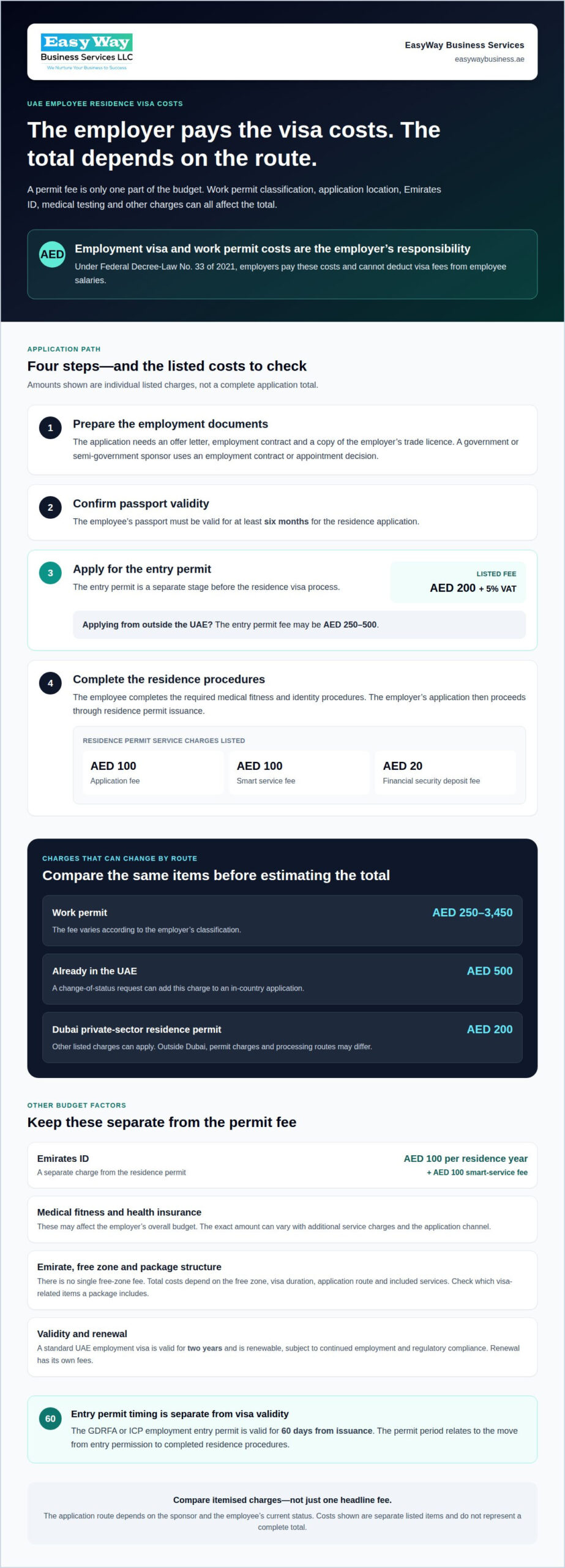
The listed structure is AED 100 for each year of residence, plus AED 100 in smart-service fees. Treat the ID amount as one part of the overall employee visa budget, not the complete cost.
What are the employee residency visa fees in UAE free zones? There is no single free-zone fee. The total depends on the free zone, visa duration, application route and services included. The residence permit and Emirates ID are separate charges; medical testing and insurance may also affect the total. A free-zone package may group some setup items, so check which visa-related costs it includes before comparing totals.
How much do UAE medical fitness tests and Emirates ID cards cost? The exact amount can vary depending on additional service charges and the application channel.
Visa fees also vary across the emirates because residence permit applications follow the relevant authority’s fee schedule. In Dubai, the standard private-sector residence permit fee is AED 200; other listed charges can apply. Outside Dubai, the permit charges and processing route may differ. Free-zone sponsorship adds another variable, because the free zone’s own application process and package structure influence the total. Compare the itemised charges, not just one headline figure.
The Emirates ID has served as proof of residence since the UAE stopped placing residence stickers in passports on 11 April 2022. Once the residence permit is issued, the ID records the holder’s identity and residency details. This means passport stamping is no longer the step that provides the residence sticker. Keep the passport and Emirates ID details consistent during the application process.
- Separate the residence permit fee from Emirates ID, medical testing, insurance and service charges.
- Compare the relevant emirate’s charges and free-zone process before estimating the total.
- Check which items are covered when a free-zone package groups visa-related services.
What Is the Cheapest Residency Visa in UAE Right Now?
There isn’t one cheapest employment residence visa for every applicant. The total depends on the employer’s work permit classification, the application route, and whether the employee is already in the country. Under Federal Decree-Law No. 33 of 2021, the employer is responsible for employment visa and work permit costs, not the employee. So compare the full employer-paid process, rather than treating one permit charge as the final cost.
For a UAE company hiring an employee, the process typically includes an entry permit, medical fitness examination, residence application and Emirates ID issuance. Applications for employment residence permits in categories under the Ministry of Human Resources and Emiratisation are processed through the Work Bundle. The sponsoring employer submits the application through the relevant official channel. The specific route depends on the sponsor and the employee’s status.
- Prepare the employment documents. The application needs an offer letter, employment contract, and copy of the employer’s trade licence. A government or semi-government sponsor uses an employment contract or appointment decision.
- Confirm passport validity. The employee’s passport must be valid for at least six months for the residence application.
- Apply for the entry permit. An employment entry permit or work visa fee is AED 200 plus 5% VAT. Applicants applying from outside the UAE may have an entry permit fee of AED 250 to AED 500.
- Complete the residence steps. The employee completes the required medical fitness and identity procedures. The employer’s application then proceeds through residence permit issuance.
Where the employee is already in the UAE, an in-country application can add charges. A change-of-status request costs AED 500. This can make an inside-country route cost more than an application made from abroad, even before work permit and service charges are considered. The appropriate application channel depends on the employee’s current immigration status and the sponsor’s process.
Work permit fees vary by the employer’s classification, from AED 250 to AED 3,450. The residence permit service also lists an application fee of AED 100, a smart service fee of AED 100, and a financial security deposit fee of AED 20. These are separate items, so don’t assume one listed fee represents the complete process. Medical testing, Emirates ID and any applicable insurance also affect the employer’s total budget.
To identify a lower-cost route, compare the same items for each application: work permit classification, entry or status-change charges, residence permit fees and required processing steps. An investor’s residence route differs from an employee visa sponsored by a UAE employer, so they are not equivalent options. The employee’s application depends on the job and sponsorship relationship, while renewal costs and procedures arise later under that sponsorship.
Employment visa validity and employer sponsorship
A standard UAE employment visa is valid for two years and is renewable, subject to continued employment and regulatory compliance. The employer pays employment visa and work permit costs, including medical testing and Emirates ID costs; employers cannot deduct visa fees from employee salaries.
Visa Validity Period
The two-year validity period gives the employee residence permission linked to their employment. Renewal depends on continued employment and compliance with applicable regulations. Check the expiry date against the employment relationship, as a new or renewed permit must reflect the employee’s current sponsored status.
An entry permit is a separate stage from the residence visa. The GDRFA or ICP employment entry permit is valid for 60 days from issuance. That period matters during the move from entry permission to completed residence procedures. A foreign employee should distinguish the entry permit’s validity from the longer residence period.
Employer Sponsorship
For an employment visa, the UAE employer acts as sponsor. This links the employee’s residence application to the job and hiring organization. The route therefore differs from other visa categories, such as student or Golden Visa applications, which have different eligibility bases.
The employer’s role continues beyond submitting the application. The employer arranges the work permit and employment residence process, while the employee completes required steps such as medical testing and identity procedures. Health insurance is mandatory for employment visa applicants, and its cost varies by policy and coverage. Confirm how insurance fits into the employment arrangements and overall hiring budget.
For a new hire, the sponsor should keep the employment record and residence status aligned. A change in employment can affect the sponsorship relationship and the next immigration steps. The employee should know which organization sponsors the permit and who coordinates each required stage.
Responsibility for Visa Costs
The employer is responsible for employment visa and work permit costs. This includes required medical testing and Emirates ID issuance, rather than the employee paying these charges as a condition of accepting the job. Visa fees must not be deducted from an employee’s salary.
For budgeting, separate employer expenses into work permit, entry and residence processing, medical fitness, Emirates ID and health insurance. These are distinct items, and the total can vary by application route, employer classification, residence duration and insurance coverage. The employee should review the written employment terms to understand how the employer handles these expenses.
Employment sponsorship is not the same as an investor arranging residence through a business investment. If your business is planning a hire, get guidance on your setup requirements and the related sponsorship process.
Employment visa validity and renewal
Plan renewal before the residence permit expires, rather than waiting for the final days. UAE employers should initiate employment visa renewal at least 30 days before the visa expiry date. This allows the employer to prepare the renewal application and account for the applicable government charges. Owners hiring staff can include that step in the employee’s contract and permit tracking process.
In Dubai, the standard private-sector residence permit renewal fee is AED 200. Outside Dubai, ICP lists a residence fee of AED 100 per year for renewals. These are permit fees, not necessarily the complete renewal cost. The total can also depend on related processing requirements and the employee’s circumstances.
Dubai’s grace period gives a limited window after expiry or cancellation. According to the General Directorate of Identity and Foreigners Affairs – Dubai, Dubai’s standard private-sector residence permit has a 60-day grace period after expiry or cancellation. Treat this as time to regularise the person’s residence status, not as a replacement for timely renewal.
After the applicable grace period, the UAE overstay fine is AED 50 per day. Each additional day can add to the amount due, so the expiry date and cancellation date matter. For example, an employee whose permit has expired should establish whether renewal or another status change is proceeding before the grace period ends.
The employee does not pay renewal costs directly because the employer is responsible for employment visa expenses. These costs must not be deducted from the employee’s salary. For budgeting, separate the government residence fee from other renewal application charges, and keep payment records with the employment documents.
An entry permit and a residence permit serve different stages. An entry permit relates to the entry process, while renewal concerns an existing residence permit. If an employee is already inside the UAE, the application route and status can affect the required steps. Do not treat an initial entry fee as a renewal fee.
Use a simple renewal sequence: record the residence permit expiry date, start the employer’s renewal process at least 30 days beforehand, and follow the application through to completion. Then retain the renewed permit details with the employee’s records. This approach helps employers distinguish the AED 200 Dubai renewal fee or ICP’s annual fee from any other application charges.
Estimated cost for a two-year private-sector employee residence visa
Use this range as a planning reference, not a universal price or fixed government tariff. The cost of a uae residency visa for employees depends on the employer’s classification and the employee’s application circumstances. A quote is useful only when you know what its total covers.
Start by separating the employee’s residence process from the company’s formation and licensing budget. These are different business costs. A commercial licence, for example, relates to the company’s ability to operate, not the employee’s residence permit. Keeping the budgets separate helps prevent confusing a company setup estimate with the cost of hiring an employee.
Next, check the scope of each estimate. One figure may cover a core government process, while another includes administrative handling or related steps. Compare totals only when you know they cover the same stages. If an estimate is incomplete, separate charges may arise later, making an initially lower figure difficult to compare fairly.
For a practical comparison, request a written breakdown for the specific employee and sponsor. The employer’s classification affects the work permit component, while the employee’s circumstances can affect the application route. The estimate should also clearly state the residence period it covers. Keep the breakdown with the hiring documents so finance and human resources teams work from the same scope.
- Confirm the estimate’s scope: identify whether it covers only government processing or additional administration.
- Match the applicant details: use the employee’s actual sponsor and application circumstances.
- Separate business costs: keep company licensing and formation outside the employee visa estimate.
- Record the assumptions: note the residence period and included stages beside the quoted total.
A private-sector employee visa should not be compared directly with an investor residence route. The sponsorship basis differs, as do the relevant costs and application steps. A property-related residence service or Golden Visa belongs to a separate category, not an employee visa estimate. Compare like-for-like employee applications covering the same residence period.
For a mainland hiring plan, keep the employee’s residence estimate distinct from the company’s commercial licence planning. Explore UAE mainland company formation with EasyWay Business Services to see how the company setup fits alongside your hiring plan across the Emirates.
EasyWay Business Services
EasyWay Business Services helps you connect company setup choices with your employee visa planning. If you’re weighing free-zone and mainland routes, it can guide you through the relevant formation procedures and help clarify how sponsorship fits your business plans. Its options include an E-Commerce License 0 Visa, free-zone licenses with one or two visas, and a Dubai Mainland commercial License.
Turn to EasyWay when you’re planning a UAE company and need to understand which setup route aligns with your hiring needs. Visa requirements and approvals depend on the relevant authorities and your circumstances. For guidance on your business setup and employee sponsorship plans, contact EasyWay Business Services.
Plan your UAE hiring pathway
Your next step is to align your hiring plans with the right company structure. Consider who will sponsor the employee, how the role fits your business and which setup route supports your operations. Clear decisions now help you plan responsibilities and prepare for the procedures ahead.
The cost of a UAE residency visa for employees is one part of a wider business setup decision. The right route depends on your company’s structure and circumstances, and requirements may vary by authority. A focused discussion can clarify how your setup choice relates to employee sponsorship and what to plan next.
EasyWay Business Services guides businesses through UAE company formation options and required setup procedures, helping you manage the process as you prepare to hire.
Discuss your UAE setup plans with EasyWay Business Services and take the next step with a clear plan for your business.
Frequently Asked Questions
How Long Does It Take, and What Does Renewal Cost?
A standard UAE employment visa process typically takes 10 to 20 business days, while renewal costs depend on the emirate and related charges. For Dubai, the private-sector residence permit renewal fee is AED 200; outside Dubai, ICP lists AED 100 per year. Employers should start renewal at least 30 days before expiry. Processing duration can vary with the application route and completion of required procedures.
Is the Visa Price Different for Indian or Pakistani Nationals?
Nationality alone doesn’t set the main cost factors listed for an employee visa. The employer’s work permit classification, the emirate, the application route and residence duration affect the fees. For example, MOHRE work permit fees range from AED 250 to AED 3,450, depending on employer classification. An Indian or Pakistani employee’s estimate should therefore be built around the sponsoring employer and application details.
What Are The General Requirements for UAE Residency Visas?
An employment residence visa requires a valid UAE job offer and employer sponsorship. Applicants must be at least 18 years old, hold a passport valid for at least six months, and complete a medical fitness examination. Health insurance is also mandatory for employment visa applicants. The employer’s application uses employment documents, while the specific process can depend on the sponsor and the employee’s current status.
What Hidden Costs Does Nobody Quote You?
Costs beyond the main permit can include medical fitness testing, Emirates ID charges, insurance, and typing or PRO services. An application made inside the UAE may also involve a AED 500 change-of-status charge. These items can make estimates differ.
Who is Eligible?
A person aged 18 or older with a valid job offer from a UAE-based organization can apply for an employment visa through the employer. The employer acts as sponsor and handles the employment-related application. The applicant must also complete required medical fitness procedures. Eligibility and application requirements can depend on the sponsor, job documentation and the applicant’s circumstances, so an employment offer by itself does not mean approval is automatic.
How much does a UAE employee residence visa cost in 2026?
This estimate can change with work permit classification, application location, medical testing, Emirates ID, insurance and service charges. Employers are responsible for employment visa and work permit costs. For a useful budget, separate government charges from other application expenses rather than relying on a single permit fee.
What are the UAE residence visa stamping or issuance fees and application charges?
Residence charges depend on the service and authority. The UAE residence permit service lists an AED 100 application fee, an AED 100 smart-service fee and an AED 20 financial security deposit. Dubai’s standard private-sector residence permit fee is AED 200, with other listed charges potentially applying. The residence sticker is no longer placed in passports; the Emirates ID serves as proof of residence.
What documents and steps are required to obtain a UAE employee residence visa?
Prepare the employee’s passport and employment documents, including an offer letter and contract. The employer’s trade licence copy is also required. A government or semi-government sponsor uses an employment contract or appointment decision. The process then proceeds through the entry permit, medical fitness examination, residence application and Emirates ID procedures. The employee completes the required identity and medical steps while the employer manages the sponsored application.