

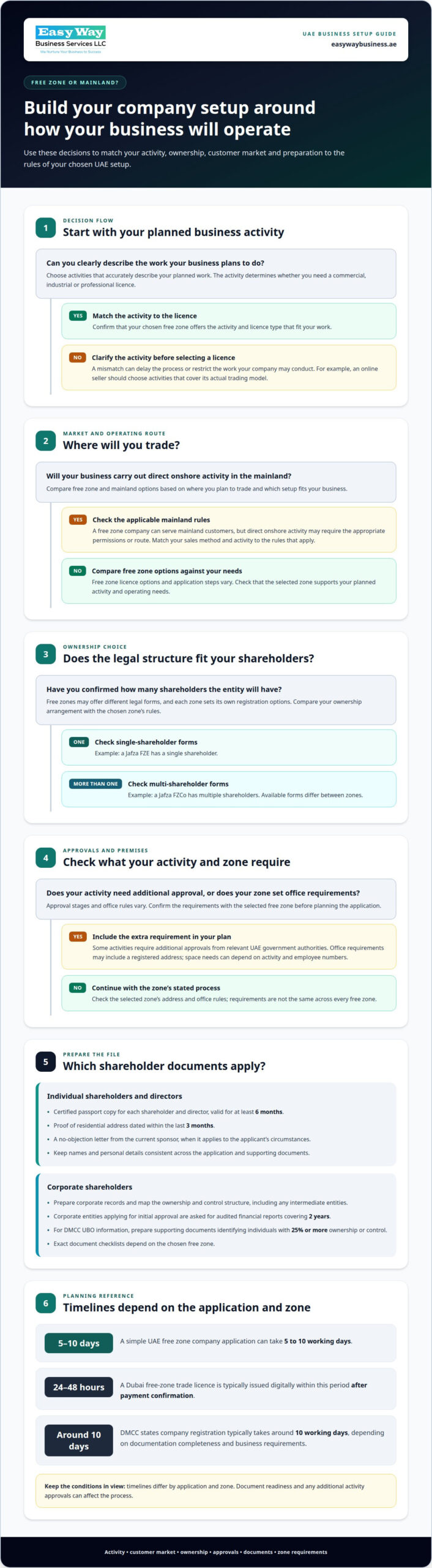
A simple UAE free zone company application can take 5 to 10 working days. The UAE free zone company setup process also depends on choosing a suitable business activity and legal structure, preparing the required documents, and meeting the chosen free zone’s office requirements. Getting these decisions right early helps you plan the steps ahead.
It’s understandable to want a clear timeline before committing to a UAE free zone company setup process. The process involves several decisions, and knowing what each one affects can help you plan your next steps.
This guide covers key structure choices, typical documents for individual and corporate shareholders, and when a physical office may be needed. You’ll also learn how an application moves from activity selection to licensing, so you can prepare for your business setup.
Key Takeaways
- Match your business activity and legal structure to the free zone’s registration options before applying.
- Prepare shareholder and director identification documents early, including a passport copy valid for at least 6 months and recent proof of address.
- Plan for the licence timeline to depend on the application, document readiness, and any additional approvals required for your activity.
- Check the selected free zone’s office rules: companies may need a registered address, while space requirements can depend on the activity and employee numbers.
- Compare free zone and mainland options based on where you plan to trade and the setup that best fits your business.
Free Zone vs Mainland – Which Structure Is Right for Your Business?
Choose a structure that fits your business activity, customer market, and operating needs. Licence options and application steps vary across the UAE’s free zones and emirates.
Legal Structures, Licence Types, and Activities
Free zones may offer different legal forms, with each zone setting its own options. A Jafza FZE has a single shareholder, while a Jafza FZCo has multiple shareholders. Compare your ownership arrangements with the chosen zone’s registration rules before selecting an entity structure. Your activity also determines whether you need a commercial, industrial, or professional licence. Choose activities that accurately describe your planned work.
Some activities require additional approvals from relevant UAE government authorities. A mismatch between your activity and licence can delay the process or restrict the work your company may conduct. For example, an online seller should choose activities that cover its actual trading model.
Trade Licences and Establishment Cards
The trade licence records the approved business activity and authorises the entity to operate within its licensed scope. After initial approval, applicants pay registration and licence fees before the free zone registers the company. Simple UAE free zone applications can take 5 to 10 working days. A Dubai free-zone trade licence is typically issued digitally within 24-48 hours after payment confirmation.
Timelines differ by application and zone. DMCC states company registration typically takes around 10 working days, depending on documentation completeness and business requirements. An establishment card and immigration card support visa sponsorship, so include them in planning if your company needs to sponsor visas.
Residence Visas and Costs
After registration, a free zone company can apply to sponsor residence visas through its immigration process. The number of visas available depends on the selected package and the zone’s requirements. Establishment and immigration cards form part of the sponsorship process, followed by the applicant’s visa procedures.
Visa-related costs depend on the free zone, visa allocation, and required processing steps. Medical and Emirates ID costs may also be part of the overall visa expenses. Visa processing and issuance remain subject to the relevant authority’s procedures.
A free zone company can serve mainland customers, but direct onshore activity is subject to applicable mainland rules and may require the appropriate permissions or route. Match your sales method and business activity to the rules that apply.
Common mistakes include choosing a licence before confirming the activity, assuming every zone offers the same legal forms, and underestimating approval stages. The UAE free zone company setup process also requires corporate tax planning. According to the UAE Ministry of Finance, qualifying income of a Qualifying Free Zone Person may be taxed at 0%, while taxable income above AED 375,000 is subject to a 9% rate. Shams Free Zone is one option to consider when comparing free zone structures: Shams Free Zone setup.
Required documents for individual and corporate shareholders
For a UAE free zone registration, prepare identity and address documents for individual shareholders and directors. Corporate shareholders also need to provide company information for initial approval. The exact checklist depends on the chosen free zone’s requirements, so organise documents by applicant and ownership structure before submitting.
Documents for individual shareholders and directors
Prepare a certified passport copy for every shareholder and director. The copy must be valid for at least 6 months. You’ll also need proof of residential address dated within the last 3 months. Keep names and personal details consistent across the application and supporting records. Differences in spelling or expired documents can slow document review.
Some initial approval applications also request a no-objection letter from an individual applicant’s current sponsor. Include one when it applies to your circumstances. Submit clear, complete copies through the free zone’s application process, and follow its instructions for any documents that need signatures or certification.
Corporate shareholders and beneficial ownership
If a parent company will hold shares, prepare its corporate records for the free zone’s review. Corporate entities applying for initial approval are asked for audited financial reports covering two years. The zone may also request information about the company’s ownership and control structure, so map the parent and any intermediate entities before starting.
Ultimate beneficial owner information identifies the individuals who ultimately own or control the business. DMCC requires supporting documents identifying individuals with 25% or more ownership or control for its UBO information. Prepare the ownership details in a clear structure, especially when a corporate shareholder sits between the applicant and its owners.
Application, signing, and registration fees
Use the selected free zone’s application portal to enter shareholder, director, activity, and entity details. UAE company formation also uses digital portals such as Basher and Invest in Dubai. Upload each supporting file in the requested format, then review the names, ownership percentages, and activity details before submitting.
After initial approval, applicants pay registration and licence fees to register the UAE free zone entity. The charges depend on the licence type and selected zone, so there is no single fee that applies across all free zones.
Follow the portal’s signing instructions for application and incorporation documents. Check that each signatory has the correct authority within the applicant or parent company. A consistent document set helps the registration review move forward. For help organising your application, you can discuss your setup requirements.
How to start a business in the UAE?
Start by matching your proposed activity and ownership structure to a free zone’s registration options. Then reserve a company name, submit the application documents, and obtain any activity-specific approvals before registration.
Free Zone and Activity Selection
Compare free zones by the activities they license, available entity structures, and requirements for your business model. Dubai has 30+ active free zones, while the UAE has 40+ free zones. Check whether your planned work fits the selected zone’s licence categories before applying. For example, a consultancy and an online trader may need different activity descriptions.
Use the activity list to describe what the business will actually do. A broad or inaccurate selection can cause problems if the licensed scope does not match your contracts, invoices, or operating model. Some activities also require additional approvals from relevant UAE government authorities.
Company Name Reservation
Submit your preferred company name through the chosen free zone’s application process. The zone reviews the proposed name before it is reserved for registration. Prepare alternatives in case your first choice is unavailable or does not meet the zone’s naming requirements. Keep the proposed name consistent across the application and incorporation documents.
Name reservation is one step, not final licence approval. The free zone also reviews the proposed activity, ownership details, and supporting documents. For a smoother application, prepare your name choices alongside your activity list rather than treating them as separate decisions.
Regulatory Approvals and Activity Requirements
Check whether your business activity needs approval from a relevant authority before licensing. Healthcare, education, and other regulated fields can involve additional review, depending on the activity. The free zone’s licensing process identifies the applicable steps. Submit accurate documents so authorities can assess the services or products you plan to offer.
A branch application also involves activity considerations. The proposed branch activity should align with the parent company’s business and the free zone’s permitted scope. Clearly describe the relationship between the parent and branch in the application to support the ownership and activity review.
Branch Ownership and Shareholder Limits
Choose the legal form around who will own the entity. A Jafza Free Zone Establishment, or FZE, has a single shareholder; a Jafza Free Zone Company, or FZCo, has multiple shareholders. A Jafza branch must be 100% owned by its parent company. Shareholder and director conditions vary by free zone, so compare the selected entity rules before submitting.
DMCC states that an FZCO must have at least one shareholder, who may be an individual or a corporate entity. DMCC also requires a director and company secretary, and one person may hold both roles. These are zone-specific examples, not universal UAE requirements.
Plan tax and accounting tasks alongside registration. Every UAE free-zone entity must register for corporate tax within the deadline applicable to its trade-licence issuance date and file annual returns, including entities qualifying for a 0% rate. According to the Federal Tax Authority, VAT registration is mandatory when taxable supplies and imports exceed AED 375,000. Keep organised records of transactions, invoices, ownership, and licence documents to support reporting and accounting work. For advice on how these tax requirements apply to your circumstances, seek guidance from EasyWay Business Services or the Federal Tax Authority.
Do I need a physical office for new business setup in Dubai?
Not every free zone setup requires a conventional office, but your licence and activity affect address and workspace requirements throughout the UAE. When working with EasyWay Business Services, you should check the chosen zone’s rules before selecting a package, especially if you need visas, staff, or a dedicated business location.
Match the office arrangement to your licence
Office requirements in UAE free zones usually depend on employee numbers and business activity. A freelancer working independently may have different workspace needs from a company employing a team or handling physical goods. Virtual offices are usually accepted for freelancer licences in UAE free zones, but the specific licence determines which arrangements are suitable.
Some zones require a registered address even if you don’t rent a private office. Free zone authorities state that all companies must have a registered office address within the designated business hub. A registered address is not necessarily the same as a dedicated, private workspace.
Before choosing, compare your activity, staffing plans, and expected working pattern with the zone’s office options. For example, a solo consultant may prioritise flexible workspace, while a business needing regular staff access may require more space. Activity and employee numbers can affect the arrangement the company must maintain.
Understand ownership and profit transfers
Start ownership planning with the selected free zone’s legal forms and shareholder rules. Record each shareholder’s role clearly, including any corporate parent, so the ownership structure matches the registration documents. The zone’s structure determines how the company is formed, and options are not identical across every free zone.
Disclose the individuals who ultimately own or control the business as part of beneficial ownership information. Free zones require supporting documents identifying individuals with 25% or more ownership or control for Ultimate Beneficial Owner information. This disclosure is separate from choosing an office, but it forms part of the company’s ownership records.
UAE free zones allow up to 100% ownership of fixed assets. Special economic zones in the UAE can allow up to 100% of profits to be returned. These points describe ownership and profit repatriation, not a promise of a particular tax result. Corporate tax treatment depends on applicable rules and the company’s circumstances.
Choose a practical office setup
List what your business needs from its location before committing: a registered address, space for staff, or a place to meet clients. Then compare those needs with the free zone’s permitted arrangements and your licence package. This helps you avoid paying for workspace that does not support your operations or choosing an arrangement that fails to meet the zone’s requirements.
For a home-based freelancer, a virtual-office option may suit the activity. A growing company with employees should assess workspace needs against its staffing plan. Confirm the address arrangement as part of the application, alongside ownership and activity details, so the company’s records align.
Free zone versus mainland setup
Choose between free zone and mainland company formation by considering where you’ll trade, who your customers are, and which activities need licensing. Free zones may suit international trade, while mainland setup can fit businesses planning domestic trade across the UAE. Let your intended sales route guide the application, not just the company’s address.
Compare the operating scope
A free zone licence ties your company’s permitted activities to the rules of its selected zone. This can suit an exporter, an online business serving international customers, or a firm operating within the zone’s approved scope. Mainland setup may suit a business whose model depends on serving customers directly across the domestic market. Map transactions, delivery arrangements, and client locations before choosing.
Direct sales to mainland customers by a free zone company depend on the activity and applicable mainland rules. Identify how your business will supply goods or services, then establish a route that fits those rules. For example, an online business selling to customers in the UAE should consider where it fulfils orders and how its licensed activity describes those sales.
Compare formation requirements
Free zone application steps and legal forms vary by zone. Mainland company formation follows the relevant mainland authority’s process. For either route, compare proposed activities, shareholder structure, office requirements, and required approvals before paying registration or licensing charges. Choose a package to suit practical needs, such as trading activities or workspace, rather than assuming one option fits every business.
Processing also depends on the authority and application. A simple free zone application can take 5 to 10 working days, while Dubai free-zone registrations are often completed within 3-5 working days. DMCC states that registration typically takes around 10 working days, depending on documentation completeness and business requirements. These different timelines show why the selected zone and a complete application matter.
Apply directly or use a consultant
You can submit an application directly. DMCC states that applicants can apply without a business setup consultant. A consultant can help compare structures, organise documents, and coordinate formation steps, which may be useful when several shareholders, activities, or approvals are involved. The choice depends on how much of the application work you want to manage yourself.
Plan banking as a separate step after formation. A company licence does not itself mean a bank account will be opened; banks assess applications using their own requirements. Prepare clear company activity and ownership information for the bank’s review. For businesses weighing domestic trading needs, compare the Dubai mainland formation option against the free zone route, then discuss your setup options.
EasyWay Business Services: E-Commerce License 0 Visa
EasyWay Business Services can help you compare setup options and work through the UAE company formation steps. If you’re planning an online business without a visa, the E-Commerce License 0 Visa may fit your needs. Other options include a Freezone license with one visa, a Freezone license with Two visa, and a Dubai Mainland commercial License.
The right choice depends on your business activity, intended market, ownership structure, and visa needs. Clear guidance can help you understand which route fits your plans and what procedures follow, including licensing and company registration.
When you’re ready to discuss your business setup, contact EasyWay Business Services for guidance on your options.
Turn Your Setup Plan Into Your Next Step
Turn your business idea into a practical decision brief. Write down what your company will sell, where its customers are, who will own it, and whether you need staff or workspace. These priorities can focus discussions and make it easier to compare suitable routes.
A clear UAE free zone company setup process starts with decisions you can make now, not assumptions about every future detail. Identify the activities your business needs, the ownership structure you intend to use, and the operational requirements that matter most. Use those priorities to shape your formation plan.
EasyWay Business Services can help you understand the available setup options and the procedures involved. For advice tailored to your plans, contact EasyWay Business Services and take the next step with a clearer direction.
Your UAE business journey can begin with one well-informed decision. Move forward at your own pace, with a plan built around your business.
Frequently Asked Questions
How long does it take for the company registration to complete?
Completion depends on how quickly the application clears each required review. Treat name approval, initial approval, registration, and licence issuance as separate milestones. Complete, consistent submissions can help avoid delays caused by missing information. Plan for any activity-related approvals, which can affect the overall schedule. Visa applications and banking are separate post-registration processes, not part of company registration itself.
How much does it cost to set up a business in the UAE?
Total costs depend on the case. Key variables include jurisdiction, licence type, business activities, visa needs, and office arrangements. Ask for a breakdown separating registration and licence charges from optional workspace and post-formation requirements. This makes proposals easier to compare and clarifies which costs apply to your business plan.
What is the difference between an FZCO and a FZE company within the free zone?
These labels generally distinguish company forms by shareholder arrangements, but their exact rules depend on the free zone. Before choosing, consider whether ownership will sit with one person, several people, or a corporate shareholder. Also check how the zone treats directors, company documents, and share capital for that specific form. The abbreviation alone does not mean the same conditions apply across every UAE free zone.
How can I setup a business in Jebel Ali Freezone?
Begin by identifying the Jafza activity and company form that fit your planned operations. Prepare ownership details and supporting corporate records, then follow Jafza’s application and review steps. If an existing company will be involved, organise its parent-company documents and explain the proposed relationship clearly. After approval, complete the required registration formalities and retain the issued company records for future operational and compliance needs.
Is the UAE good for setting up a business?
The UAE can suit entrepreneurs seeking access to regional and international markets, but it isn’t automatically the right fit for every business. The Global Entrepreneurship Monitor 2023/24 Global Report ranked the UAE first globally as a place to start a new business for the third consecutive year. Use this as context, then assess your own customer base, operating costs, compliance responsibilities, and route to market before committing.
Top Free Zones in Dubai: Which One Is Right for You?
The right Dubai free zone is the one whose operating framework suits your company, not simply the one with the best-known name. Compare application requirements, ongoing administration, office arrangements, and support relevant to your business model. Jafza and DMCC are examples of zones with distinct registration conditions. Build a shortlist and compare each zone with your priorities and practical constraints.
What are the steps to set up a UAE free zone company?
Plan the setup as a sequence of decisions and approvals: define the business model, select a suitable zone and entity form, reserve a name, and submit the application. After approval, complete registration and licensing formalities. Before trading, organise internal company records and post-formation tasks. Corporate tax and VAT obligations depend on applicable rules and your circumstances; consult EasyWay Business Services or the Federal Tax Authority for guidance specific to your situation.
How do you choose the right UAE free zone for your business activity?
Shortlist zones that accept your intended activity, then compare how each fits your operating model. Consider whether the activity description accurately covers your planned services or products and whether additional approvals may apply. Weigh practical factors such as the zone’s application process and ongoing administrative requirements. A useful comparison focuses on what your company must do after formation, not only on the licence application.