

You can own 100% of a UAE free-zone company without a UAE residence visa. That’s the key point for anyone weighing how to start a business in UAE as a non-resident: you can begin the company setup process from abroad, but your business still needs a physical address to operate in the UAE.
It’s natural to wonder whether you need a residence visa before setting up a business in another country. In practice, the right route depends on what your business will do and where it will operate. Your activity, company structure and licence need to align, and some activities may require additional government approvals.
This guide explains how to compare Free Zone, Mainland and Offshore structures, choose a licence and prepare for setup from abroad. It also covers when a visa may be useful, how premises and documents fit into the process, and where activity-specific approvals may apply, so you can plan your next steps with more confidence.
Key Takeaways
- You can own 100% of a UAE free-zone company without a UAE residence visa, but the business needs a physical address in the UAE.
- Choose between free-zone, mainland and offshore structures based on where you plan to operate and who you intend to serve.
- Check your business activity early, since some activities require additional government approvals before you can operate.
- The Federal Tax Authority states that the UAE corporate tax rate is 9% on taxable profits exceeding AED 375,000, while qualifying Free Zone income may be taxed at 0% subject to conditions.
- EasyWay Business Services offers options including an E-Commerce License 0 Visa and free-zone licenses with one or two visas to support different setup needs.
Do you need a residence visa to register a Free Zone company in Dubai?
No. A non-resident can own 100% of a UAE Free Zone company without holding a UAE residence visa. Company ownership and your personal residence plans are separate matters, so consider each independently before applying.
- Choose your ownership structure first. Non-residents can hold 100% ownership in a UAE Free Zone company without a UAE residence visa. Identify each owner and prepare their details consistently for the application documents.
- Decide whether you need a residence visa for personal reasons. Owning a company does not, by itself, mean you must live in the UAE. If you plan to relocate, treat your residence arrangements as a separate part of your planning.
- Plan your business premises before submitting the setup application. Businesses operating in the UAE need a physical address. For a Dubai office or warehouse, the tenancy contract must be registered through Dubai Land Department’s Ejari portal.
- Prepare premises information alongside your company documents. Keep the proposed address consistent across the application and tenancy paperwork, and distinguish the UAE business location from your overseas home address in your records.
- You can apply for a UAE business bank account as a non-resident. Banks assess applications individually, and their document requests and checks depend on the business and applicant. Prepare accurate company and owner information, then follow the bank’s specific application process.
- Consider tax obligations as part of your setup planning. The Federal Tax Authority states that the UAE corporate tax rate is 9% on taxable profits exceeding AED 375,000. The UAE VAT rate is 5%, and mandatory registration applies when annual turnover exceeds AED 375,000, according to the Federal Tax Authority.
- Keep organized accounting records from the start. Record income, expenses, invoices and supporting documents by transaction. These records help you understand the company’s financial position and prepare information for tax administration and business decisions.
- Build compliance tasks into your operating routine. Track licence conditions, company documents, premises details, accounting records and relevant tax responsibilities. For tax questions, consult the Federal Tax Authority or a qualified tax adviser familiar with your circumstances.
- Use a practical setup sequence: settle ownership, identify the business activity, arrange Dubai premises, and prepare company documents. Submit the Free Zone application, then organize banking and accounting records. This order helps keep the address, activity, and company information aligned.
Free Zone, mainland and offshore company structures
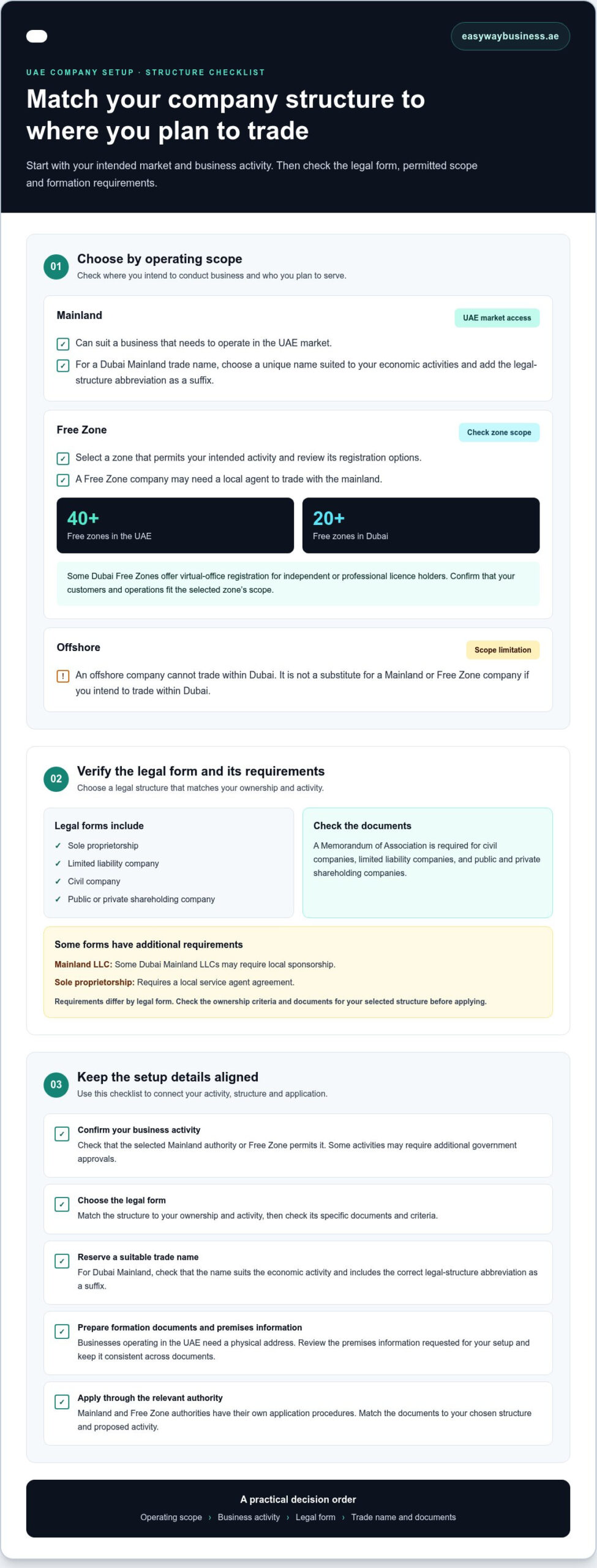
Choose a structure by matching your business activity and intended market to its operating scope. Then select a legal form and licence that fit the ownership and setup requirements.
-
Compare available company structures
Compare Free Zone, mainland, and offshore options against where you plan to conduct business. A mainland company can access the UAE market, while an offshore company cannot trade within Dubai. A Free Zone company may need a local agent to trade with the mainland. The UAE has more than 40 free zones, so compare each zone’s permitted activities and setup options.
Dubai has more than 20 Free Zones. Some offer virtual-office registration for independent or professional licence holders. Check whether your planned customers and operations fit the selected zone’s scope. Don’t treat an offshore structure as a substitute for a mainland or Free Zone company if you intend to trade within Dubai.
-
Select a legal structure
Choose a legal form that matches your ownership and activity. UAE structures include sole proprietorships, limited liability companies, civil companies, and public or private shareholding companies. A Memorandum of Association is required for civil companies, limited liability companies, and public and private shareholding companies.
Check the documents and ownership criteria for your selected form before applying. Some Dubai mainland LLCs may require local sponsorship. A sole proprietorship requires a local service agent agreement. These requirements differ by legal form, so avoid choosing a structure based only on its name or perceived simplicity.
-
Plan mainland or free-zone setup
A Mainland setup may suit businesses that need to operate in the UAE market. For a Dubai Mainland trade name, select a unique name suited to your economic activities, then include the legal-structure abbreviation as a suffix. Check that the name, activity and legal form align before submitting your application.
For Free Zone setup, select a zone that permits your intended activity and review its registration options. Many modern UAE free zones are designated under official cabinet decisions, and their licence holders can benefit from 100% company ownership. Consider mainland access needs before choosing a zone.
-
Complete formation and licensing
Set your sequence: confirm the activity, choose the legal form, reserve a suitable trade name, prepare formation documents and apply for the relevant licence. Mainland and Free Zone authorities have their own application procedures. Match every document to the chosen company structure and proposed business activity.
Before filing, review the trade name, ownership details, Memorandum of Association where required, and any premises information requested for your setup. If the choice between mainland and Free Zone depends on your customers or operating model, discuss your setup options before submitting an application.
Additional government approvals
Identify approval requirements before finalizing your UAE company application. The activity and location determine which authorities may need to review the proposal.
- List each activity your business will carry out. Use precise descriptions when preparing your application, since approval needs can differ by activity. In Dubai, medical clinics and legal consultancies are examples of activities requiring approval from relevant government authorities. Don’t assume a general business licence alone covers every activity you plan to practise.
Separate your core service from related services in your plan. This makes it easier to identify whether each activity needs its own review. For example, a proposed medical clinic should account for relevant authority approval alongside its business setup application.
- Check whether your chosen location affects the approval route. In Abu Dhabi, additional approvals may be required from other entities depending on the business activity and location. Consider both factors together before filing, rather than treating location as a later administrative detail.
Describe the planned premises and the work performed there consistently in your documents. A business activity may be assessed differently depending on where it operates. Build this location review into your initial planning, especially if the activity involves a regulated service.
- For a UAE Mainland setup, understand what initial approval means. It is a government no-objection that allows an investor to proceed with setup. It does not authorize the investor to operate the business or practise its activity. Treat it as a step toward formation, not as the final operating licence.
Keep the stages distinct in your setup plan. First secure the required initial approval, then complete the remaining formation and licensing procedures. Don’t begin the proposed activity based only on receiving initial approval.
- For an Abu Dhabi setup, apply for initial approval from ADDED. This approval allows you to proceed with setting up the business. It does not replace additional approvals that may apply to your activity or location.
Prepare a clear description of your intended business and proposed location for the application. Use the same information throughout the process. If the activity or location changes, reassess which approvals may apply before moving forward with setup.
- Map approvals into a simple sequence before submitting documents. Record the business activity, proposed location, initial approval stage, and any relevant authority review. For a Dubai medical clinic or legal consultancy, include the relevant government authority approval in your planning.
Keep evidence of each approval with your company records. Compare the approved activity and location against the business you intend to operate. This helps you spot a mismatch before relying on a licence or approval for the wrong activity.
Benefits of setting up a Dubai business remotely
Remote planning lets you assess Dubai as a business base before arranging travel. Use these practical considerations to test whether the location and setup match your plans.
- Assess Dubai’s location against your target markets. Dubai is within a four-hour flight radius of more than 2 billion people. That reach can be useful if your business serves customers across nearby markets. Map your target locations, delivery model, and customer support needs before deciding where to operate.
For example, an online business may serve customers across borders without relying on walk-in traffic. Define where you expect to sell and how you’ll deliver your product or service. This helps clarify which activities and licence options fit your business model.
- Use remote preparation to organize setup decisions before travelling. Gather your ownership details, activity description and company documents in one place. Keep company information consistent across forms, and separate tasks you can prepare remotely from any appointments that require personal attendance.
This distinction helps you plan a visit around specific tasks rather than travelling before you understand the process. Your document readiness and the relevant authority’s requirements shape which steps you can complete from abroad.
- Consider the time difference when planning international work. Dubai is four hours ahead of the UK, or three hours ahead during British Summer Time. Set meeting windows that work for your customers and team. For UK-facing operations, some working hours may overlap.
Include customer support, supplier calls and internal meetings in your operating plan. That practical schedule can help you assess whether your team can serve its intended markets from the UAE.
- Include tax research in your remote planning, but don’t assume a particular outcome for your company. The Federal Tax Authority describes 0% corporate tax on qualifying Free Zone income, subject to conditions. The UAE has a 0% personal income tax rate, but your individual position may also depend on your circumstances outside the UAE.
Treat these figures as general information, not a prediction of your liability. Discuss your planned activity and income with the Federal Tax Authority or EasyWay Business Services for guidance relevant to your situation.
- Consider Dubai’s long-term economic direction alongside your own business case. Dubai’s Economic Agenda D33 aims to double Dubai’s economy in the decade to 2033. Use that ambition as context, then assess your customers, operating model, and ability to deliver your offer.
Create a remote planning checklist covering target customers, business activity, company structure, premises and documents. This gives you concrete decisions to work through and helps compare the location with your business objectives.
Business activity and license types
Define the work your company will perform before selecting its licence. The activity shapes the licence application and may affect other approvals.
- Write a clear list of your planned business activities. The UAE has more than 2,000 economic activities, so describe the actual work rather than relying on a broad business label. For example, distinguish selling products online from providing consulting services. Use descriptions that reflect your real offer, customers, and delivery method.
In Abu Dhabi, determining the activity is the first step toward legal recognition. Treat it as a foundation for choosing the right licence, not as wording to finalize after submission. If your business has several revenue streams, list each one for assessment.
- Match each activity to the licence permissions you need. An economic licence in Abu Dhabi allows a business to practise a specific economic activity after meeting applicable legal terms and conditions. That means the licence should describe the work you intend to do, not simply the general sector you operate in.
Compare the proposed activity against your business plan and customer offer. A company providing digital marketing, for instance, should make sure its stated activities cover the services it intends to deliver. Don’t assume one activity automatically includes related services.
- Compare activity availability across potential Free Zones. UAQ Free Trade Zone lists more than 1,500 business activities as eligible for its licences. Use the activity list to see whether the proposed work fits that zone’s licensing scope before choosing a setup route.
Check the exact activity wording and whether your business model needs more than one activity. A software company that also sells products, for example, should consider both functions while planning its licence application. Keep the chosen description consistent across setup documents.
- Choose a licence based on the business function, not just a label. Consider whether your company will trade goods, provide professional services or carry out another defined activity. The activity determines what the licence authorizes, while the company structure and location guide the wider setup.
Separate the activity decision from your preferred company name or branding. A name may communicate your market position, but it does not define the approved work. Prepare a concise explanation of how the company earns revenue and delivers its services.
- Review the activity list before filing your application. Check that each planned service or product is represented and that the selected licence matches your operating model. If your plans change later, reassess whether the licence still reflects the company’s work and whether new approvals apply.
For help aligning your intended activities with a suitable UAE licence, discuss your licensing options before you submit the application.
EasyWay Business Services: E-Commerce License 0 Visa
EasyWay Business Services helps you compare UAE company setup options and work through the formation process. If you’re planning an online business, its E-Commerce License 0 Visa may fit your setup needs. Freezone license options with one visa or Two visa are also available, alongside a Dubai Mainland commercial License.
Choose based on your activity, preferred jurisdiction and visa needs. These options differ, so match the setup to your operating plans before proceeding. EasyWay Business Services assists with Free Zone, Mainland and Offshore company formation, licensing and visa processing, helping you understand the setup options relevant to your business.
Contact EasyWay Business Services to discuss your UAE business setup.
Turn your UAE business plan into a clear next step
Turn your business idea into a practical setup plan. Write down what you’ll sell, who you’ll serve and how you expect to operate. These decisions give you a focused starting point for company formation discussions and help keep your application aligned with your business goals.
If you’re deciding how to start a business in UAE as a non-resident, use your plan to identify the questions that matter most. EasyWay Business Services can explain suitable setup options and guide you through the relevant procedures. Share your intended activity, preferred jurisdiction, number of shareholders, required visas, nationality and residency status, and desired timeline to get a tailored recommendation.
Contact EasyWay Business Services about your UAE setup and move your business plan forward with confidence.
Frequently Asked Questions
How to start a company in Dubai without living there?
You can plan a company setup from abroad by choosing your business activity, deciding on a structure and preparing the required documents. Then submit the application through the relevant authority and complete any location- or activity-specific steps. To understand how to start a business in the UAE as a non-resident, discuss your intended activity, ownership, preferred jurisdiction, number of shareholders, visa needs, nationality and residency status, and desired timeline with EasyWay Business Services or the relevant authority.
Can a non-resident foreigner own 100% of a UAE business?
A non-resident can own 100% of a UAE Free Zone company without a UAE residence visa. Mainland ownership depends on the activity and company structure, so don’t assume one ownership arrangement applies to every business. Before choosing, outline who will own the company and what it will do. EasyWay Business Services or the relevant authority can advise on the requirements for your proposed setup and applicant circumstances.
What are the UAE business setup options for non-residents: mainland, free zone, or offshore?
Mainland, Free Zone, and offshore structures serve different operating plans. Mainland may suit a business targeting the UAE market. A Free Zone setup depends on the selected zone’s licensed activities and operating scope. An offshore company is not suitable for trading within Dubai. Compare your customers, activities, and intended operations, then ask EasyWay Business Services or the relevant authority for guidance on which structure fits your circumstances.
How do you choose the right UAE free zone for a non-resident business?
Start by matching your intended activity to the Free Zone’s licence options. Then compare its registration process, premises arrangements, and operating scope with your business model. For example, an independent professional can assess whether a zone’s virtual-office option suits the planned activity. Since requirements vary between authorities and applicant profiles, discuss your proposed setup with EasyWay Business Services or the relevant Free Zone authority before deciding.
What documents are required to register a UAE company as a non-resident?
Typical documents include passport and visa copies for shareholders and managers, plus personal information for the company manager and shareholders. A UAE resident may need a No Objection Certificate in some cases. Authorities can request additional records based on activity, jurisdiction, ownership and applicant profile. Prepare your identification and ownership details first, then discuss your circumstances with EasyWay Business Services to understand which documents may apply.
What are the steps and timelines to register a company in the UAE remotely?
First define your activity and ownership, then choose a jurisdiction and legal structure. Prepare the application documents, submit them to the relevant authority and complete any required premises- or activity-related procedures. There is no single timeline for every remote setup: document readiness, authority review and additional approvals affect the process. EasyWay Business Services can guide you through the steps for your circumstances, while the authority determines its application requirements.
Does a non-resident UAE company need a local office or registered address?
A business operating in the UAE needs a physical address, while premises options depend on the selected jurisdiction and licence. Some Free Zones offer virtual-office registration for independent or professional licence holders. For a Dubai office or warehouse, tenancy registration requirements apply. Before selecting an address, explain your activity and operating model to EasyWay Business Services or the relevant authority so you can understand the premises requirements for your specific setup.
Can a UAE company owned by a non-resident sponsor visas or employ staff?
A UAE company may apply for employee work permits and residence visas through the relevant procedures. The application requirements depend on the licence, company arrangements, role, and applicant documents. Don’t assume company ownership alone determines visa eligibility or approval. If you plan to hire or seek a visa, discuss your circumstances with EasyWay Business Services or the relevant immigration and labour authorities for guidance on the applicable process.