

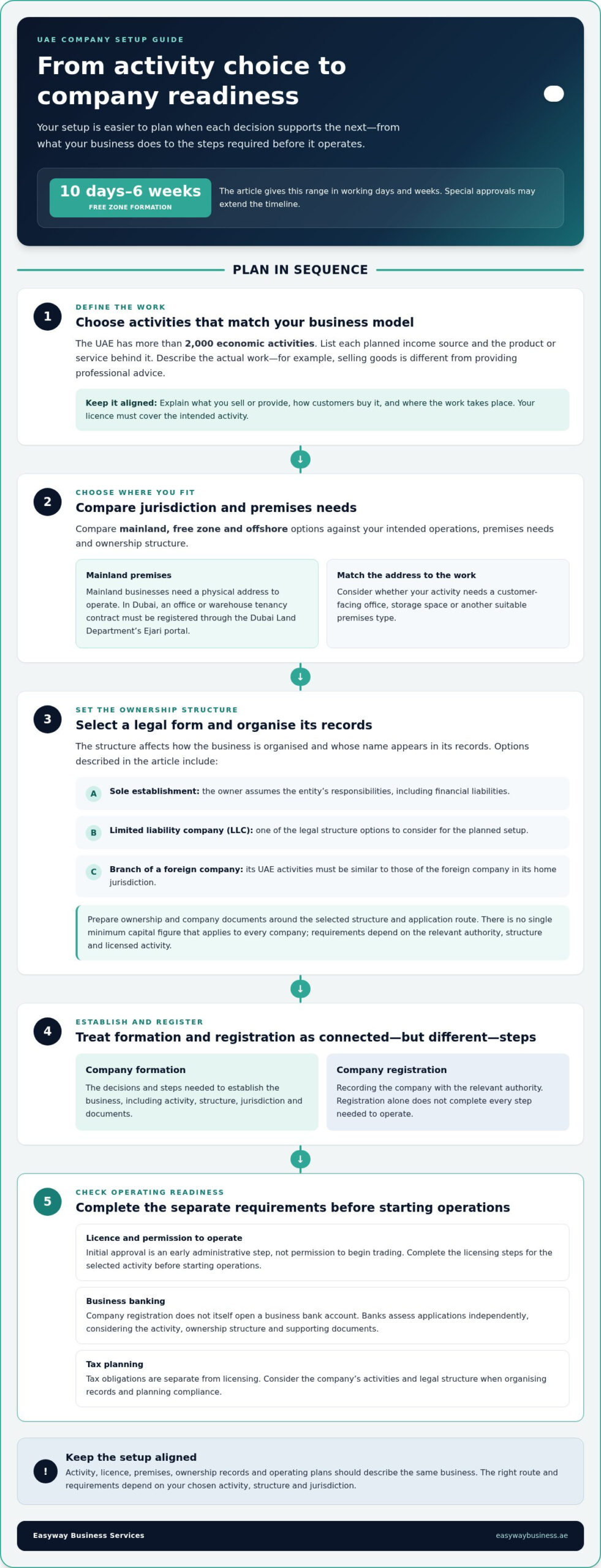
A UAE free zone company can take from 10 working days to six weeks to form, and special approvals may extend the timeline. The company formation in UAE requirements also depend on your permitted business activity, ownership documents and chosen jurisdiction. Registration is one step in the process; it isn’t the whole setup.
When planning company formation in UAE, it’s understandable to focus on how quickly you can get started. But choosing a setup based on speed alone can leave important questions about licensing, ownership and where your business can operate unanswered.
This guide explains the difference between company formation and registration, the documents and decisions involved, and how mainland and free zone choices shape your setup. It also covers the factors that influence timelines, so you can plan your next steps around your business needs.
Key Takeaways
- Free zone company formation can take from 10 working days to six weeks, with special approvals potentially affecting the timeline.
- Choose permitted business activities before applying for a licence, since the activity shapes the approvals and setup route your business needs.
- Separate company formation from registration: completing registration does not, by itself, mean every step needed to operate is complete.
- Compare mainland, free zone and offshore options against your intended operations, premises needs and ownership structure.
- Prepare ownership and company documents around the chosen legal structure to keep the application process clear and organised.
Business licensing and permitted activities
Your licence must reflect the activities your company intends to carry out. Start by defining those activities, then align the legal structure and licence type with your planned operations.
Business Activity Selection
The UAE has more than 2,000 economic activities, so choose descriptions that accurately match your business model. For example, a company selling products and one providing professional advice need activity selections that reflect different work. List each planned source of income and the service or product behind it. This gives you a clearer basis for selecting activities during the application.
Legal Structure Options
Your legal structure affects how the business is organised and whose name appears in its records. Options include a sole establishment, a limited liability company (LLC), and a branch of a foreign company. A sole establishment owner assumes the entity’s responsibilities, including financial liabilities. A foreign company’s UAE branch may conduct commercial activity and earn profits, but its activities must be similar to those of the foreign company in its home jurisdiction.
Business Activity and License Types
Activities and licence types work together: the licence must cover the work the company plans to perform. A commercial activity, such as selling goods, calls for a different activity description than providing professional services. Define the actual work rather than relying on a broad label. Then compare that activity with the licence route available in your chosen jurisdiction, including the mainland company formation process.
Before filing, describe each product or service, how customers will buy it, and where the work will take place. For example, an online seller should distinguish selling goods from providing advice through a website. These details help keep the proposed activity, licence application and operating plan aligned.
Initial approval is an early administrative step, not permission to begin trading. It does not authorize an investor to run the business or conduct its activity. Licensing is a separate requirement: complete the steps for the selected activity before starting operations. Distinguishing approval from authorization helps prevent a premature launch.
Tax planning also belongs in the setup checklist. According to the Federal Tax Authority, the UAE corporate tax regime took effect on 1 June 2023. Consider the company’s activities and legal structure when organising records and planning compliance. Licensing identifies the permitted business activity; tax obligations are a separate matter to address as part of operating the company.
UAE Company Registration vs Company Formation: What’s the Difference?
Company formation covers the decisions and steps needed to establish a business. Registration records the company with the relevant authority, while premises and banking arrangements affect its readiness to operate.
Business Premises and Location
Plan the business address alongside its location and operating model. UAE mainland businesses need a physical address to operate. In Dubai, a tenancy contract for office or warehouse space must be registered through the Dubai Land Department’s Ejari portal. Consider whether your work needs a customer-facing office, storage space or another suitable premises type. The address should support the activity you intend to carry out.
Minimum Capital Requirements
What are the minimum capital requirements for UAE companies? There is no single minimum capital figure that applies to every company. The relevant authority, legal structure and licensed activity determine the requirement for a specific setup. Before filing, identify the proposed structure and activity, then establish whether the formation documents must state a capital amount. This helps keep the company’s records aligned with its chosen setup.
Registration is one part of formation, not a substitute for business planning. Before selecting a route, clarify where you will trade, what you will sell or provide, and whether your work depends on a physical location. For example, a warehouse-based seller has different premises needs from a consultant serving clients remotely. These practical details can shape jurisdiction and address decisions.
Treat banking as a separate operational step. Registering a company does not itself open a business bank account. Banks assess applications independently, and the company’s activity, ownership structure and supporting documents inform that review. Keep the business description consistent across the licence and account applications. For example, an online retailer should describe its sales activity consistently in both sets of records.
Compare potential setups in a clear sequence. First, match the activity to the business model. Next, decide whether your operations require mainland premises or suit a free zone location. Then review the ownership structure and documents needed for that route. Finally, plan for account opening as a separate step once the company’s records are in place.
These choices connect the legal setup to daily operations. A business that needs a Dubai office should factor in the tenancy contract and Ejari registration. A business with no premises requirement still needs to choose a location that fits its licensed activity. To discuss how your planned activity and address affect the setup route, raise your company formation questions.
Company documentation and ownership structure
To form a UAE company, define its ownership, legal structure, activity and jurisdiction, then prepare the documents for that route. Company formation in UAE requirements depend on these choices and the application process that follows.
Company Ownership Structure
Set out who will own the company and how each owner will participate before preparing its records. The ownership structure should match the selected legal form, such as a limited liability company or a shareholding company. For a mainland LLC, shareholders and directors must visit the UAE to sign the articles of association unless they use a power of attorney. Plan signing arrangements early, especially when owners are based in different countries.
Required Incorporation Documents
The required incorporation documents depend on the legal form. An MOA, or memorandum of association, is required for civil companies, limited liability companies, and public or private shareholding companies. Treat it as a core document for these forms, and ensure it reflects the company’s agreed ownership and structure. A sole establishment follows a different legal form, so its document requirements should not be assumed to match an LLC’s. Align the MOA with the owners’ agreed arrangement before submitting it.
Application Documents
Application documents can differ by jurisdiction and company type. Some UAE free zone company applications may require audited financial reports covering two years or a bank reference certificate. These relate to the application review and are not a universal document list for every UAE company. Identify the chosen free zone and application route, then organise the records relevant to that submission. Consider company formation in UAE requirements alongside the ownership structure and selected jurisdiction.
Keep ownership details consistent across every document. For example, if two founders plan to hold shares in an LLC, the ownership information in the MOA should reflect their agreed arrangement. A mismatch between the stated owners and the company’s constitutional document can lead to avoidable corrections during preparation. Review names, roles and ownership details together before submitting the application.
Use a straightforward preparation sequence. First, confirm the legal form and list its owners. Next, determine whether that form requires an MOA. Then arrange signing, including a power of attorney if mainland LLC shareholders or directors will not sign in person. Finally, check whether the selected free zone application calls for audited reports or a bank reference certificate. This sequence connects the ownership decision to the paperwork needed for formation.
Mainland, free zone and offshore jurisdictions
Choose a jurisdiction by matching your business activity, intended location and ownership plans. Then select the route, confirm the activity and name, prepare documents, complete the authority’s steps and obtain the licence. A free zone may be a poor fit if its permitted activities do not match your operations.
Jurisdiction Structures
Mainland companies, free zone entities, and offshore companies are different jurisdiction options, not interchangeable labels. The UAE has more than 40 free zones, while Dubai has three offshore zones. Compare where your business will operate and which activities it needs to carry out. For mainland ownership, an amendment effective 1 June 2021 permitted 100% foreign ownership, subject to activity and relevant authority approvals.
Mainland and Free Zone Setup
Mainland and free zone setups differ in location and process. A UAE mainland LLC generally takes six to eight weeks to incorporate, depending on required authority approvals. Free zone formation ranges from 10 working days to six weeks, and special approvals may extend the timeline. Most free zone entities can be incorporated without founders visiting the UAE. Match the location to your operating plans before choosing a route.
Company Setup Steps
Follow a clear sequence. First, identify the business activity and suitable jurisdiction. Next, choose a unique trade name that is not similar to another registered company. Prepare ownership and incorporation documents, then complete the relevant application and approvals. Arrange the required business premises for a mainland setup. Obtain the licence before starting the licensed activity.
Free Zone Risks and Restrictions
A key risk is a mismatch between the free zone’s permitted activities and your actual business model. For example, a company planning to sell goods and provide consulting should account for both activities when selecting its licence. Special approvals can also affect setup time. Review the intended activity, jurisdiction, location and any required approvals together before committing to a free zone structure.
For mainland companies, premises are part of the setup decision, not an afterthought. In Dubai, an office or warehouse tenancy contract must be registered through the Dubai Land Department’s Ejari portal. Factor in practical needs such as customer meetings or storage when selecting an address and planning the application.
Offshore formation is another route, with a distinct purpose and setup process. A UAE offshore company can generally be incorporated within five working days. Compare this option with your planned operations rather than choosing by speed alone. The right jurisdiction aligns the company’s licensed activity, ownership structure and intended place of business.
Company registration versus formation
Company formation is the full process of establishing a business, while registration records it with the relevant authority. Treat registration as one milestone within formation, not as proof that every operational step is complete.
The distinction matters because a business passes through several separate stages. You choose a jurisdiction and legal structure, prepare the application, complete required approvals, register the entity and obtain its licence. Each stage serves a different purpose. Registration creates the company’s formal record; formation also covers the decisions and approvals needed to reach that point.
For example, a founder may have an approved company name and submitted registration documents but still need to complete licensing steps before conducting the licensed activity. Initial approval does not authorize an investor to run the business or conduct its activity. Planning around this distinction helps set realistic launch milestones and avoids treating an early approval as the finish line.
Registration also connects the company to local records. A UAE company must register with the Chamber of Commerce and Industry in the same emirate where it is incorporated. This makes the incorporation emirate relevant beyond the initial application. Keep the company’s jurisdiction, registration records and operating plan aligned throughout formation.
Timelines refer to a particular route and stage, rather than one universal process. Company setup through a Department of Economic Development takes 4 days. That figure describes the stated setup process through that department, not necessarily every separate task a founder must complete. Document preparation, premises arrangements, and additional authority approvals can form part of the wider formation plan.
Use these milestones to track progress:
- Plan: Select the legal structure, jurisdiction, and intended business activity.
- Prepare: Assemble ownership and incorporation documents for the selected route.
- Apply: Submit the application and complete the required authority steps.
- Register: Record the company with the relevant authority and the Chamber of Commerce and Industry in its emirate.
- Complete: Obtain the licence and address remaining operational requirements before trading.
This sequence clarifies what “company registered” means in practice. It marks a formal milestone, while “company formed” describes the broader journey from choosing a setup to completing its required steps. A business planning to operate in Dubai, for instance, should track registration alongside its licence and premises arrangements, rather than treating registration alone as its launch measure.
Map your formation stages to your planned launch, and discuss your UAE company setup to understand how the steps fit your situation.
EasyWay Business Services: E-Commerce License 0 Visa
EasyWay Business Services helps you understand UAE setup options and manage the formation process. Turn to the team when you need to compare a free zone and mainland route or organise the steps for your chosen business activity.
Available options include the E-Commerce License 0 Visa, a free zone licence with one visa, a free zone licence with two visas, and a Dubai Mainland commercial licence. The right option depends on your business plans, ownership structure, and intended jurisdiction. EasyWay Business Services can guide you through the relevant procedures and help reduce administrative complexity.
Contact EasyWay Business Services to discuss your company setup.
Turn your setup plan into a clear next step
Before moving forward, write down what your business will do, where it needs to operate and who will own it. Use these decisions to guide your next discussion and keep application details aligned with your plans.
Understanding company formation in UAE requirements is a starting point, not a substitute for matching the setup to your circumstances. If you’re weighing jurisdiction options or want help organising the steps, EasyWay Business Services can guide you through the available routes and procedures. Requirements and approvals can vary according to the activity, jurisdiction and individual circumstances.
Share your business plans and questions with the team to discuss a suitable next step. Contact EasyWay Business Services to talk through your UAE company setup. A thoughtful plan can help you move ahead with greater clarity and confidence.
Frequently Asked Questions
How long does it take to set up a UAE Free Zone Company?
Free zone company formation takes 10 working days to six weeks. Special approvals can extend that timeframe. For planning, distinguish the authority’s formation process from your own preparation: agree the activity descriptions, ownership details, and launch priorities before submitting. That lets you use the processing period productively, rather than waiting to resolve basic business decisions while the application progresses.
How long does it take to set up a UAE Mainland LLC?
A UAE mainland LLC generally takes six to eight weeks to incorporate, depending on required authority approvals. Use this estimate for planning, not as a guaranteed launch date. Set internal deadlines for confirming the ownership arrangement, preparing signatures and arranging the business address. These tasks can proceed alongside the application and help keep the wider launch plan organised.
Is it necessary to visit the UAE to set up a company?
No, a visit isn’t necessary for every company setup. Most free zone entities can be incorporated without founders visiting the UAE. For a mainland LLC, shareholders and directors sign the articles of association in the UAE unless they use a power of attorney. If founders are abroad, decide who will sign and how documents will be executed before scheduling travel.
How much time is needed to set up your company in the UAE?
The timeline depends on the company’s jurisdiction and setup route, so use the estimate for your specific structure rather than a general figure. Free zone and mainland processes have different durations, and offshore setups follow another route. Build a schedule around decisions you control, including selecting activities and preparing ownership information, then track authority processing separately from your planned opening date.
What documentation is required to open a company in the UAE?
Typical documents include passport and visa copies for shareholders and managers, along with personal information for the manager and owners. UAE residents may need a No Objection Certificate when applicable; tourist or visitor visa holders generally do not. Gather these details in a consistent file for each person, and label documents clearly so the application information can be prepared accurately.
What documents are required to register a UAE company?
The document set depends on the legal form and selected application route. Some free zone applications may request audited financial reports covering two years or a bank reference certificate. Prepare one folder for the company’s constitutional records and another for applicant materials. This helps distinguish documents that establish the company from supporting records used in an application review.
What is the difference between UAE mainland, free zone, and offshore companies?
These options differ in where and how a business is set up, so start with your intended operations. A mainland business needs a physical address, while free zone and offshore routes have their own formation arrangements. For example, a business that relies on local office premises should include its address plan in the jurisdiction decision, rather than choosing a route based only on its name.
Can foreign nationals own 100% of a UAE company?
Yes, foreign nationals may own 100% of a UAE mainland company, subject to the activity and relevant authority approvals. The practical next step is to identify the exact business activity before finalising the ownership plan. That allows the proposed shareholding to be considered alongside the company’s structure and application route, instead of assuming one ownership arrangement applies to every business.