
A strong Portugal D2 visa application presents a clear, supported business case, not a promise of approval. If you’re unsure which steps come first or which online claims to trust, start by defining what you plan to do and what evidence can explain your proposal.
This guide explains how to organize your business information and personal documents, check current instructions, and avoid common misunderstandings about eligibility, investment, and approval. Requirements and procedures can depend on your circumstances and where you apply, so use general guidance as a starting point, not a substitute for current official instructions.
Think of your application as a practical account of your business plans, how you intend to pursue them, and the supporting information relevant to your case. Preparing documents can help you present that account clearly, but it can’t guarantee a visa decision. EasyWay Business Services advises on overseas opportunities, including Portugal’s D2 visa, and can help clarify preparation priorities based on your intended activity and circumstances. The relevant Portuguese authorities make the final decisions. Use the steps ahead to identify what you know, what needs verification, and which questions to raise.
Key Takeaways
- Understand what the Portugal D2 route is intended to support before you commit time or resources to an application.
- A clear portugal d2 visa application organizes business evidence separately from personal and identity information.
- Don’t assume a business plan, a particular investment amount, or a standard timeline guarantees the same outcome for every applicant.
- Build your preparation sequence around your business idea, relevant evidence, and the latest official instructions for your application location.
- EasyWay Business Services can help clarify your circumstances and preparation priorities, while Portuguese authorities make the visa decisions.
Portugal D2 visa application: what the route is meant to support
Before investing time or resources in a Portugal D2 visa application, get clear on its purpose. The route is commonly described as an entrepreneur-focused Portuguese visa category, but check the current official terminology and instructions with the relevant Portuguese authority. A business idea alone doesn’t establish eligibility, and preparing an application doesn’t determine its outcome.
In brief: A D2 application presents a proposed business or professional activity and supporting information for assessment by the relevant authority. Preparation helps you explain your case; the authority makes the decision.
Portugal’s visa categories sit within a wider immigration framework. The general Visa policy of Portugal provides background, but it isn’t a substitute for current official guidance about a specific route or application.
Who may be exploring a D2 application?
Entrepreneurs planning to develop a business in Portugal and self-employed professionals considering independent work may be researching this route. That doesn’t mean everyone in these groups qualifies. Your proposed activity, personal circumstances, and application location may affect which route or instructions are relevant.
Start by writing down what you intend to do, who the activity is meant to serve, and how you expect to carry it out. For example, someone planning to establish a business may need to explain the proposal differently from a professional planning to provide services independently. These are planning distinctions, not eligibility tests. Don’t assume that nationality, a particular investment amount, or a general online rule determines your case. Verify the current requirements for your circumstances.
What the application needs to communicate
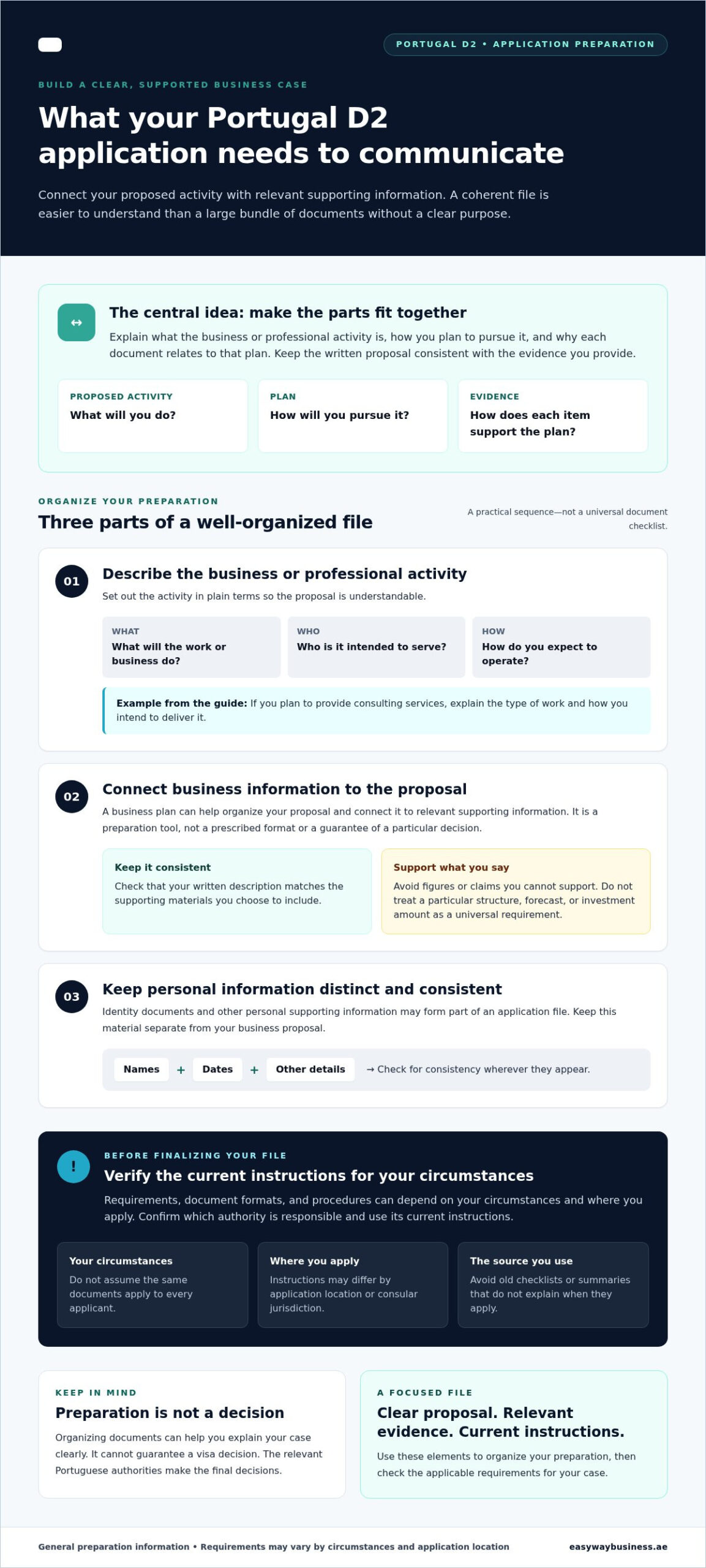
A clear case connects the proposed activity to relevant supporting information. Make it easy to understand what the business or professional activity is, how you plan to pursue it, and why each document relates to that plan. The aim is coherence, not simply a large bundle of paperwork.
A business plan can help organize the proposal, but it is preparation material, not an approval guarantee. Keep it consistent with the evidence you provide. If your written description says one thing while supporting documents suggest another, the case may be harder to understand. Check the documents and formats against current official instructions, which may vary by applicant location or consular jurisdiction.
General information can help you organize questions, but it can’t determine how a rule applies to your individual case. For tailored guidance, prepare your intended business activity, preferred jurisdiction, number of shareholders, required visas, nationality or residency status, and desired timeline. These details help make the discussion specific to your plans. Then verify applicable forms and requirements with the responsible Portuguese authority.
What a Portugal D2 application may need to demonstrate
A useful way to prepare is to ask what each piece of information is meant to clarify. Rather than collecting documents without a clear purpose, organize your file around the proposed activity and the personal information the application requests. Exact requirements can depend on your circumstances and the responsible authority, so treat general guidance as a starting point, not a universal checklist.
Organized, consistent evidence helps your application communicate its purpose by showing how the proposed activity and supporting information fit together.
Business information and supporting materials
Describe the activity in plain terms: what your business or professional work will do, who it is intended to serve, and how you expect to operate. A business plan can help you set out these points and connect them to relevant supporting information. It is a preparation tool, not a prescribed format or a guarantee of a particular decision.
For example, if you plan to provide consulting services, explain the type of work and how you intend to deliver it. Make sure the proposal is understandable and consistent with the materials you choose to include. Don’t present a particular structure, forecast, or investment amount as a universal requirement, and avoid adding figures or claims you can’t support. Check current official instructions before deciding what evidence belongs in your file.
Personal documents and case-specific requirements
Identity documents and other personal supporting information may form part of an application file. Keep this material separate from your business proposal, and check that names, dates, and other details are consistent wherever they appear. Don’t assume that a document requested for one applicant or application location will automatically be required in the same way for someone else.
Use the current checklist and instructions for your route and circumstances. Confirm which authority is responsible for your application and whether the process differs based on where you apply. If an instruction is unclear, seek clarification from the relevant authority or discuss your circumstances with EasyWay before submitting. Avoid relying on an old checklist, a list copied from a different jurisdiction, or an online summary that doesn’t explain when it applies.
Before seeking case-specific guidance, sort your information into two working groups: material that explains the proposed business activity, and personal or identity information requested for your application. Note gaps or inconsistencies, then write down questions about the applicable checklist, document format, or submission process. This makes it easier to discuss your circumstances without mistaking general information for an official requirement.
If you’d like help clarifying your preparation priorities, share your intended activity, preferred jurisdiction, number of shareholders, required visas, nationality or residency status, and desired timeline through a discussion about your D2 application. EasyWay can help you identify questions and possible next steps; the responsible Portuguese authority determines the requirements and outcome of your Portugal D2 visa application.
Portugal D2 visa myths: separate preparation from approval
A prepared file can make your case easier to understand, but it can’t turn uncertainty into certainty. For a Portugal D2 visa application, separate what you can control, such as clarity and organization, from requirements and decisions set by the relevant authority. Treat online claims about documents, investment, or timing as points to verify, not universal rules.
Myth: submitting every listed document guarantees approval
Reality: A checklist helps you prepare, but completing it doesn’t guarantee a positive decision. The documents requested and how a case is assessed may depend on the applicant, route, and authority responsible for the application. A file can be complete and still require an assessment of its contents. Only the responsible authority determines the outcome.
Myth: every applicant follows one fixed formula
Reality: An online example may describe one person’s circumstances or an earlier process, not yours. Requirements and instructions can differ by application route or location, and they can change. Use examples to identify questions, not to copy someone else’s file. Check the current instructions for your case with the responsible Portuguese authority. EasyWay can also help you organize questions around your circumstances.
Myth: there is one universal investment amount
Reality: Don’t assume a figure quoted online is a fixed threshold that applies to every applicant. It may be outdated, specific to one situation, or presented without a source. Before making financial commitments, verify whether current official guidance sets a relevant requirement for your route and circumstances. Another applicant’s budget doesn’t prove that the same amount will suit your proposed activity.
Myth: processing times are predictable
Reality: A timeline shared in a forum or older article isn’t a promise of how long your case will take. Processing can depend on the applicable procedure, where you apply, and the authority’s current handling of applications. Check current estimates and instructions through official channels, and allow flexibility in plans that depend on a decision. Don’t make business or relocation commitments based only on an online estimate.
Before acting on a specific claim, ask three questions: Is it from a current official source? Does it apply to your route and application location? Does it reflect your personal circumstances? If the answer isn’t clear, pause and seek case-specific guidance. This approach helps you prepare realistically without confusing careful preparation with a guaranteed result.
How to prepare for a Portugal D2 visa application
A clear preparation sequence helps you identify what you know, what you still need to verify, and which questions call for case-specific guidance. Work through these steps before making commitments based on assumptions or examples from other applicants.
Build a clear applicant and business profile
Start with a short written profile. Describe your intended business activity and preferred jurisdiction, then record your number of shareholders, required visas, nationality or residency status, and desired timeline. These details help EasyWay understand your circumstances before discussing tailored next steps. They don’t establish eligibility or predict an authority’s decision.
Check the current route and organize your questions
Confirm the current application route and instructions with the responsible Portuguese authority. Check which forms apply, where and how to submit them, and what supporting documents are requested for your circumstances. Mark online claims as verified, unverified, or unclear so old examples and forum discussions don’t become mistaken for official requirements.
Use this practical sequence to turn your initial idea into an organized preparation file:
- Describe the activity. Summarize what your business or professional work will do and how you expect to operate.
- Record your circumstances. Gather your profile details, including the people involved and your intended timing.
- Group your information. Keep business-related material separate from personal and identity documents. Note what each item is intended to explain.
- Check official instructions. Verify current forms, submission steps, and document details for the route and application location that apply to you.
- List gaps and questions. Flag missing information, inconsistencies, and any point you can’t verify. Keep the source beside each important claim.
- Seek case-specific guidance. Share your organized profile and questions with EasyWay or the relevant authority, as appropriate.
For broader background while keeping your own requirements separate, you can review this Portugal D2 visa application guide. Treat general explanations as context, then verify current forms and procedures through the responsible official channel. Requirements may vary with individual circumstances and the applicable process.
This sequence is a planning aid, not legal or immigration advice, and it can’t confirm eligibility or guarantee an outcome. Before seeking tailored guidance, prepare your intended activity, preferred jurisdiction, number of shareholders, required visas, nationality or residency status, and desired timeline. To discuss your preparation priorities, discuss your D2 visa application with EasyWay Business Services.
How EasyWay can guide your Portugal D2 application next
Preparing for a Portugal D2 visa application can raise questions about your business plans, personal circumstances, and what to verify next. EasyWay Business Services helps entrepreneurs and investors set up companies in the UAE and advises on overseas opportunities, including Portugal’s D2 visa. For your preparation, the focus is practical: explain your situation, organize your questions, and clarify possible next steps.
Useful guidance starts with the facts of your case, not a promise of a particular outcome. Bring a clear summary of your plans and circumstances so the discussion can focus on relevant questions rather than generic assumptions.
What to share when requesting tailored guidance
Before a discussion, prepare a short profile with the details below. They help EasyWay understand the context before offering tailored guidance. Share what you know and identify any details you still need to clarify.
- Intended business activity: Explain what you plan to do and how you expect the activity to operate.
- Preferred jurisdiction: State where you hope to establish or carry out the activity.
- Number of shareholders: Note how many people are expected to own or participate in the business.
- Required visas: Describe who may need a visa in connection with your plans.
- Nationality or residency status: Provide the relevant status details for the people involved.
- Desired timeline: Share your target dates or planning window, without assuming a particular processing time.
These details help shape a relevant conversation, but they don’t establish eligibility. Tailored recommendations depend on the information you provide and the requirements that apply through the responsible authority. If your plans are still developing, say so. Distinguishing confirmed decisions from open questions is more useful than presenting assumptions as settled facts.
What guidance can and cannot do
Support can simplify preparation by sorting questions, identifying what needs current verification, and clarifying practical next steps. It can also help you understand where general information ends and where your individual circumstances need closer attention. For example, if you’re unsure whether an online document list applies to your application location, make that a specific point to verify rather than treating the list as definitive.
Guidance cannot guarantee visa approval, a government decision, or a processing time. Requirements and assessments may vary, and the relevant Portuguese authority decides the outcome. Verify current immigration instructions, forms, and document requirements with that authority before submitting or making commitments based on an assumed result.
Start with your activity, preferred jurisdiction, number of shareholders, visa needs, nationality or residency status, and target timeline. Then bring your questions forward for a focused discussion. Speak with EasyWay about your situation to clarify preparation priorities and possible next steps.
Move forward with a clearer plan
Your next step doesn’t have to be a major commitment. Turn what you’ve learned into a short project brief: what you want to build, what you still need to verify, and which decisions depend on official guidance. This gives you a practical starting point for discussing your Portugal D2 visa application without treating preparation as a promise of approval.
EasyWay Business Services advises on overseas opportunities, including Portugal’s D2 visa, and provides end-to-end UAE business setup and corporate services. A discussion can help clarify your circumstances and identify useful next steps. For immigration requirements or a decision on your case, rely on the relevant Portuguese authority.
Plan your next steps with EasyWay. Bring your business idea and the questions you want answered. With a clearer brief, you can approach the process thoughtfully and move toward your plans with confidence.
Frequently Asked Questions
Is the Portugal D2 visa only for people who have already started a business?
No. Don’t assume you must already have an operating company, or that a business idea alone will meet current requirements. A proposed activity may form part of the case, but whether your circumstances fit the route depends on the applicable rules and the responsible authority’s assessment. Before spending on setup or making commitments, check the current official instructions and seek guidance based on your situation.
Can a self-employed professional apply for a Portugal D2 visa?
Possibly, but being self-employed doesn’t automatically make the D2 route suitable. Consider how your planned work will be carried out and what information can support that plan. For example, a freelancer should be ready to explain the services they intend to provide, while checking what supporting evidence is relevant to their circumstances. Confirm current requirements before relying on an online summary or preparing a submission.
How much investment is required for a Portugal D2 visa application?
Don’t treat an online figure as a universal current requirement. Investment claims can be outdated or taken out of context, and what applies may depend on the proposed activity and current rules. Check official guidance for your route and circumstances before making financial commitments. EasyWay can help you clarify questions to raise, but case-specific requirements should be verified with the responsible authority.
How long does a Portugal D2 visa application take?
There’s no timeline you should treat as guaranteed. Processing can depend on the route, responsible authority, your circumstances, and the application file. An estimate published elsewhere may relate to a different procedure or period. Check current official information and leave flexibility in plans such as business launch dates, travel, or accommodation. Avoid commitments that depend on receiving a decision by a particular date.
Can I submit a Portugal D2 visa application while living in the UAE?
Possibly, but living in the UAE alone doesn’t establish which submission route applies. The appropriate process may depend on your nationality, residence status, and the jurisdiction responsible for handling your application. Before booking or submitting anything, confirm the current route and document instructions through the relevant Portuguese authority or application channel. Don’t assume another resident’s checklist or process applies to your individual case.
Does a Portugal D2 visa application automatically include family members?
Don’t assume that an application for the main applicant automatically covers family members or settles their separate documentation needs. If you plan to move with relatives, raise this early and check current official guidance for each person’s circumstances and process. Keep family-related questions distinct from your business proposal so you can verify the relevant requirements. No general explanation can promise a particular outcome for family members.
Is a Portugal D2 visa the same as a D7 visa?
No. The D2 and D7 are separate Portuguese visa categories, so don’t treat their purposes or requirements as interchangeable. Broad online comparisons may not reflect current official descriptions or your individual circumstances. Start by identifying the activity or circumstances you want the route to support, then compare that with current guidance from the responsible authority. EasyWay can help you frame questions, but the authority determines how requirements apply.