
To get a two-year Dubai property-owner residence visa, you need a completed property in Dubai. If you’re a co-owner, your share must be worth at least AED 400,000, and your passport must be valid for more than 6 months. If you’re learning how to get an investor visa in the UAE, note that processing typically takes 10 to 15 working days once your documents are complete and the application is approved.
Getting an investor visa in the UAE involves more than proving you own property. You need the correct ownership documents and must complete the required residence visa steps. Preparing in advance helps keep the process clear and organized.
This guide explains property eligibility, which documents to prepare, and what to expect during the application process. It also compares property-owner visas with other investor residence options to help you identify a route that may suit your plans.
Key Takeaways
- Understand how the property-owner route differs from investor residency options linked to business investment or long-term residence.
- For the real estate investor route, the Federal Authority for Identity, Citizenship, Customs & Port Security sets a minimum total property value of AED 2 million.
- Prepare the ownership and identity documents relevant to your property and application before starting the process.
- Know the main application stages and what can affect how long processing takes.
- The Federal Authority for Identity, Citizenship, Customs & Port Security states that the UAE Golden Residence Permit for investors is valid for 10 years and can be extended if the same conditions are met.
UAE 2-Year Investor Property Visa Requirements
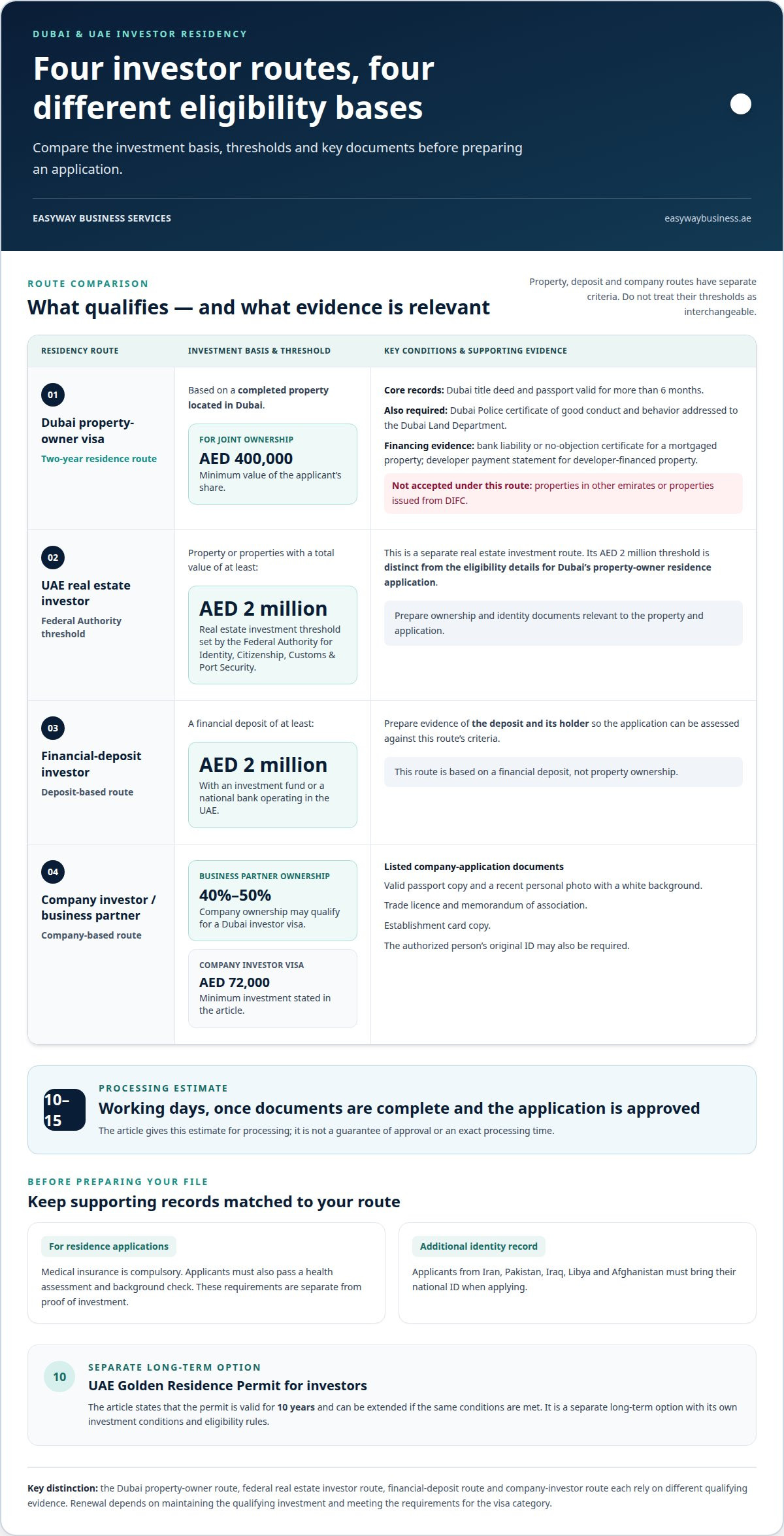
Eligibility depends on the route: property ownership, a financial deposit, or investment in a company. Each has different criteria, so identify the basis for your residency application before gathering documents.
For the UAE real estate investor route, the Federal Authority for Identity, Citizenship, Customs & Port Security requires property or properties with a total value of at least AED 2 million. This is a real estate investment threshold; it is distinct from Dubai’s property-owner residence application, which has its own eligibility details.
For a Dubai property-owner visa, the property must be completed and located in Dubai. The application requires a Dubai title deed, and a passport valid for more than 6 months. Properties in other emirates and properties issued from DIFC are not accepted under this route. A Dubai Police certificate of good conduct and behavior addressed to the Dubai Land Department is also required.
Joint ownership has a separate threshold for Dubai’s property-owner visa. Joint ownership can affect eligibility for Dubai’s property-owner visa. For example, the relevant amount is the value of the applicant’s share, not simply the property’s full value. A mortgaged property requires a bank liability or no-objection certificate; developer-financed property requires a developer payment statement.
A financial-deposit investor follows a different path from a property owner. The Federal Authority for Identity, Citizenship, Customs & Port Security requires a financial deposit of at least AED 2,000,000 with an investment fund or one of the national banks operating in the UAE. Prepare evidence of the deposit and its holder so the application can be assessed against this route’s criteria.
Company investment eligibility also differs from property eligibility. A business partner may apply for a Dubai investor visa with ownership of 40% to 50% in a company, and a company investor visa requires a minimum investment of AED 72 thousand. The documents listed for a company-based application include a valid passport copy, a recent white-background photo, the trade licence, the memorandum of association, and an establishment card copy. The authorized person’s original ID may also be required.
How do these routes compare with Golden Visas and business partner visas? A property-owner visa is based on qualifying real estate, while a business partner route depends on company ownership. The Golden Residence Permit is a separate long-term option, with its own investment conditions and eligibility rules.
Renewal depends on maintaining the qualifying investment and meeting the requirements for your visa category. Investor visas can have different validity periods, so check the permit type and expiry date when planning a renewal.
If the business closes or the property is sold, the basis for the visa changes. Address the resulting visa status and follow the applicable cancellation or replacement process. Do not assume the existing residency remains valid.
Required documents
Prepare documents for your chosen route, whether it is property ownership or company investment. A complete application should connect your identity, investment evidence, and UAE sponsor or company records.
Company Investor Visa Requirements
A company investor application is based on your ownership and the company’s records. The listed documents include a valid passport copy, a recent personal photo with a white background, the trade licence, memorandum of association, and establishment card copy. The original ID of the person authorized on the establishment card is also listed. Keep the licence and ownership documents together so the application clearly relates to the same company and investor.
Application Documents and Health Insurance
For a residence visa application, prepare identity and company documents that match your route. Medical insurance is compulsory for residence permit applications. Applicants must also pass a health assessment and background check. These are separate from proof of investment, so include the relevant property or company evidence alongside your personal records.
For a Dubai property-owner application, the title deed establishes ownership and identifies the Dubai property linked to the residency request. The application also requires a passport valid for more than 6 months and a Dubai Police certificate of good conduct and behavior addressed to the Dubai Land Department. Keep the title deed details consistent with the applicant named in the application.
- Property ownership: Include the Dubai title deed.
- Mortgaged property: Add a liability or no-objection certificate from the bank.
- Developer-financed property: Include the developer’s payment statement.
- Personal identity: Prepare a passport copy and recent white-background photo.
- Company investment: Include the trade licence, memorandum of association, and establishment card copy.
Each record serves a different purpose. The title deed or company documents show the investment basis, while your passport and photo identify you. A bank certificate or developer statement explains the property’s financing status. Organize documents by category before submission, and make sure the relevant sponsor or company is clearly identified in the supporting records.
Some applicants must also provide national identification. Applicants from Iran, Pakistan, Iraq, Libya, and Afghanistan must bring their national ID when applying. Include it with your identity documents rather than relying on a passport copy alone.
Use the application route to decide which evidence belongs in your file. For help organizing your investor visa application documents, you can request guidance before submission.
Application processing time
Use a personal timeline to track your UAE investor visa application, without confusing progress updates with a final decision. Record the submission date, reference number, latest status, and any action still pending. This gives you a clear view of the application and helps focus follow-up.
If you’re working out how to get an investor visa in the UAE, focus on the steps you can manage. Keep submitted information and correspondence together. Note who sent each update and whether you need to respond. This makes it easier to pick up the process after an appointment or time away from your application.
Create a simple tracker with clear status labels, such as submitted, awaiting an update, or requiring your response. Use the authority’s wording when recording a status instead of interpreting it as approval. This helps you avoid treating an in-progress application as an issued residence permit.
- Application record: Save the reference number and submission confirmation together.
- Status log: Add each official update and the date it arrived.
- Action list: Record requests that require a response and who will handle them.
- Planning notes: Keep travel or work arrangements flexible until the application outcome is clear.
Keep your contact details accessible throughout the application. If an authority or processing channel sends an update, you can identify the relevant file and respond through the appropriate route. Avoid keeping separate versions of the same record, as conflicting information can complicate follow-up.
Use your tracker to distinguish application progress from personal planning. If a move, work commitment, or travel arrangement depends on residence approval, leave room to adjust your plans. A processing update describes the application’s status; it does not confirm that a permit has been issued.
Knowing how to get an investor visa in the UAE also means understanding what you can manage: organized records, timely attention to messages, and a clear view of outstanding actions. Keep the person coordinating your paperwork and the latest status visible, especially if someone else is helping with the application.
Before making plans based on an expected outcome, review the latest official update instead of relying on an older message. This keeps your decisions tied to the current application status and helps you identify the next step without repeating completed work.
Visa processing time
For a Dubai property-owner residence visa, issuance typically takes 10 to 15 working days after documents are complete and the application is approved. This is a practical planning range, not a guaranteed date. The timeline depends on completing the required stages and receiving the necessary approval.
Other investor visa timelines may use a different measure. A Dubai investor visa is described as taking about 3 working days to be issued, while the expected completion time for the investor residence permit service is 5 days. These figures refer to different service descriptions, so don’t treat them as interchangeable promises for every property-owner application.
The property-owner process has several milestones. First, submit the application for review by the relevant authority. After approval, complete medical testing, proceed with Emirates ID issuance, and obtain final residency stamping. The visa is issued after these steps are processed, so consider the full sequence rather than relying on an estimate for a single stage.
- Submission and review: The authority assesses the application and supporting documents.
- Approval: The application must be approved before later residence steps proceed.
- Medical testing: The applicant completes the required test.
- Emirates ID: The identity document is issued as part of the residence process.
- Residency stamping: The final step completes the residence permit process.
Document readiness affects the timeline. Missing or incomplete records can delay review, and the stated property-owner estimate assumes document completion and approval. For example, an application awaiting a required ownership record cannot proceed as smoothly as a complete file.
Keep each processing stage distinct. “Issued” can refer to the visa outcome, while medical testing and Emirates ID processing are separate milestones before final residency stamping. Depending on the application route, a certificate or supporting record may also need to be assessed.
Use working days as stated for the 10 to 15 working day estimate; don’t convert it into calendar days. Track the application from submission through approval, medical testing, Emirates ID issuance, and stamping. If one stage remains outstanding, that is the point to clarify before planning around the final permit date.
For a realistic schedule, organize your documents before submission and allow time for each required milestone. The authority’s review and approval, along with completion of residence formalities, determine when a Dubai property-owner visa can be issued.
What types of UAE investor visas are available, and who qualifies?
Your investment type points to the relevant UAE residency route. Property owners, company investors, public investors, and financial depositors follow different criteria, so identify your route before preparing an application.
Dubai property-owner residence: In Dubai, an individual property owner may be able to apply for an investor residence visa, subject to the applicable requirements. The property must be completed and located in Dubai. A co-owner applying through this route needs a share worth at least AED 400,000. This Dubai route is separate from federal real estate investment criteria and long-term Golden Residence options.
Real estate investment: For the UAE real estate investor route, the Federal Authority for Identity, Citizenship, Customs & Port Security requires property or properties with a total value of at least AED 2 million. A Dubai property investor visa with a three-year term requires property worth AED 1 million or more. A five-year property investor visa requires property worth at least AED 5 million. These thresholds relate to distinct residence categories, not one interchangeable property visa.
Company and public investment: A company investor visa in Dubai requires a minimum investment of AED 72 thousand. A business partner may apply with ownership of 40% to 50% in a company. For public investment, the Federal Authority for Identity, Citizenship, Customs & Port Security requires an applicant to hold a share in company assets valued at no less than AED 2 million. The company investment route and public-investment route have separate qualifying tests.
Financial deposit: An investor using a deposit must hold at least AED 2,000,000 with an investment fund or one of the national banks operating in the UAE. This is a separate basis from owning property or shares in a company. The evidence should show the deposit and the qualifying financial institution.
Golden Residence Permit: The Federal Authority for Identity, Citizenship, Customs & Port Security states that the UAE Golden Residence Permit for investors is valid for 10 years and can be extended if the same conditions are met. Real estate investors may qualify for a Golden Residence Permit based on their property holdings. Entrepreneurs with existing projects may qualify with minimum capital of AED 500,000.
Compare the investment type, ownership evidence, and intended residence period before selecting a route. If you’re weighing a property, company, or deposit-based application, get guidance on your investor visa options.
EasyWay Business Services
EasyWay Business Services helps you understand suitable UAE company setup options and the procedures connected with your plans. If your investor visa route involves establishing a business, the team can guide you through company formation steps and licensing choices.
Available options include an E-Commerce License 0 Visa, a Freezone license with one visa, a Freezone license with Two visa, and a Dubai Mainland commercial License. The right fit depends on your business activity and setup needs. Use the earlier eligibility and document details to clarify whether a company-based route matches your investment plans before moving forward.
For guidance on your UAE business setup and investor visa process, contact EasyWay Business Services.
Take the Next Step With a Clear Plan
Your next move is to align your residency goal with the investment you intend to maintain. If your plans include building a UAE business, consider how the company setup and licensing route fits your wider objectives. EasyWay Business Services offers an E-Commerce License 0 Visa, a Freezone license with one visa, and a Freezone license with Two visa.
Understanding how to get an investor visa in the UAE starts with choosing the route that matches your circumstances and preparing for the next steps. For business setup guidance, EasyWay can explain your options and the procedures involved. Eligibility and decisions depend on the relevant authority and your individual circumstances.
Contact EasyWay Business Services to discuss your next step and move forward with a clearer plan. Your UAE plans can take shape one informed decision at a time.
Frequently Asked Questions
What are the UAE investor visa requirements for company owners and shareholders?
Company investors need to meet the investment and ownership criteria for their specific route. A Dubai company investor visa requires a minimum investment of AED 72 thousand, while a business partner may apply with 40% to 50% company ownership. Prepare company records that support your role, including the trade licence and memorandum of association. The authority assesses eligibility and the application documents for the chosen category.
What is the minimum investment required for a UAE property investor visa?
The minimum depends on which property-based route you mean. For the UAE real estate investor route, the Federal Authority for Identity, Citizenship, Customs & Port Security sets the total property value threshold at AED 2 million. Dubai’s property-owner residence application is a distinct route, with eligibility depending on the ownership circumstances.
How much does a UAE investor visa cost, including government fees and medical tests?
These figures do not establish one total for every applicant. The amount depends on the application route and required procedures, including medical testing and Emirates ID processing. Confirm the charges that apply to your case before planning your budget.
What documents are required to apply for a UAE investor visa?
Prepare a passport copy and a recent personal photo with a white background, then add documents for your investment route. A company application can require the trade licence, memorandum of association, and establishment card copy. A Dubai property-owner application uses the title deed and may require a bank liability or no-objection certificate for a mortgaged property. Applicants from Iran, Pakistan, Iraq, Libya, and Afghanistan must bring national identification.
What are the steps to apply for a UAE investor visa, and where do you apply?
First, identify your visa route and assemble evidence for the property, company, or deposit investment. Submit the application through the relevant UAE channel, then complete the required approval and residence steps. Dubai Investor Residence applicants must attend in person. The Dubai property-owner process includes application review, medical testing, Emirates ID issuance, and final residency stamping. The responsible authority and application route determine the exact submission arrangements.
How long does a UAE investor visa take to process, and how long is it valid?
A Dubai property-owner residence visa typically takes 10 to 15 working days after documents are complete and the application is approved. The property-owner permit is valid for two years. Other investor categories may have different processing estimates and validity periods, so don’t assume one timeline applies to every route. Allow for the approval, medical, Emirates ID, and residency-stamping stages when planning your move.
Can UAE investor visa holders sponsor family members?
Yes, a Dubai investor visa holder can sponsor a spouse and children as dependents, who receive UAE residence visas. Each dependent needs a separate application with its own supporting documents and residence procedures. Plan for these applications alongside the main investor application rather than assuming dependents are added automatically. Requirements depend on each family member’s circumstances and the immigration process for the relevant residence category.
Do UAE investor visas provide a path to permanent residency or citizenship?
An investor residence visa is a time-limited residence permit, not permanent residency or citizenship. A separate long-term option is the UAE Golden Residence Permit for investors. The Federal Authority for Identity, Citizenship, Customs & Port Security states that it is valid for 10 years and can be extended if the same conditions are met. Eligibility depends on meeting that permit’s investment criteria; holding an investor visa alone doesn’t establish qualification.