

Did you know that 100% foreign ownership is now the standard for most mainland activities, yet many entrepreneurs still lose weeks to avoidable paperwork? You’ve likely heard that Dubai is the ultimate land of opportunity, but the actual requirements to start a business in Dubai for expats can feel like a maze of hidden fees and conflicting advice. It’s completely natural to feel overwhelmed by the bureaucracy when you’re trying to build something new in a foreign market.
We’ve designed this 2026 roadmap to strip away the confusion and give you a straight path to your trade license and residency. You’ll discover exactly what’s needed to launch your UAE venture successfully while avoiding common pitfalls. We’ll walk you through the essential document checklist, explain the latest tax regulations, and help you choose the jurisdiction that fits your specific goals. By the end of this guide, you’ll have a clear, actionable plan to turn your professional dreams into a reality without the stress of navigating the legal landscape alone.
Key Takeaways
- Learn how to navigate the specific requirements to start a business in Dubai for expats by choosing between Mainland and Free Zone jurisdictions.
- Discover the essential legal steps for selecting your business activity and securing a compliant trade name that meets UAE regulations.
- Map out your residency path from applying for an Establishment Card to processing your Investor or Employment visa and Emirates ID.
- Gain confidence in managing your operational setup, including the complexities of opening a corporate bank account and establishing your digital presence.
- See how partnering with a seasoned expert can streamline the formation process and help you avoid the common hurdles of UAE bureaucracy.
Choosing Your Jurisdiction: Mainland vs. Free Zone for Expats
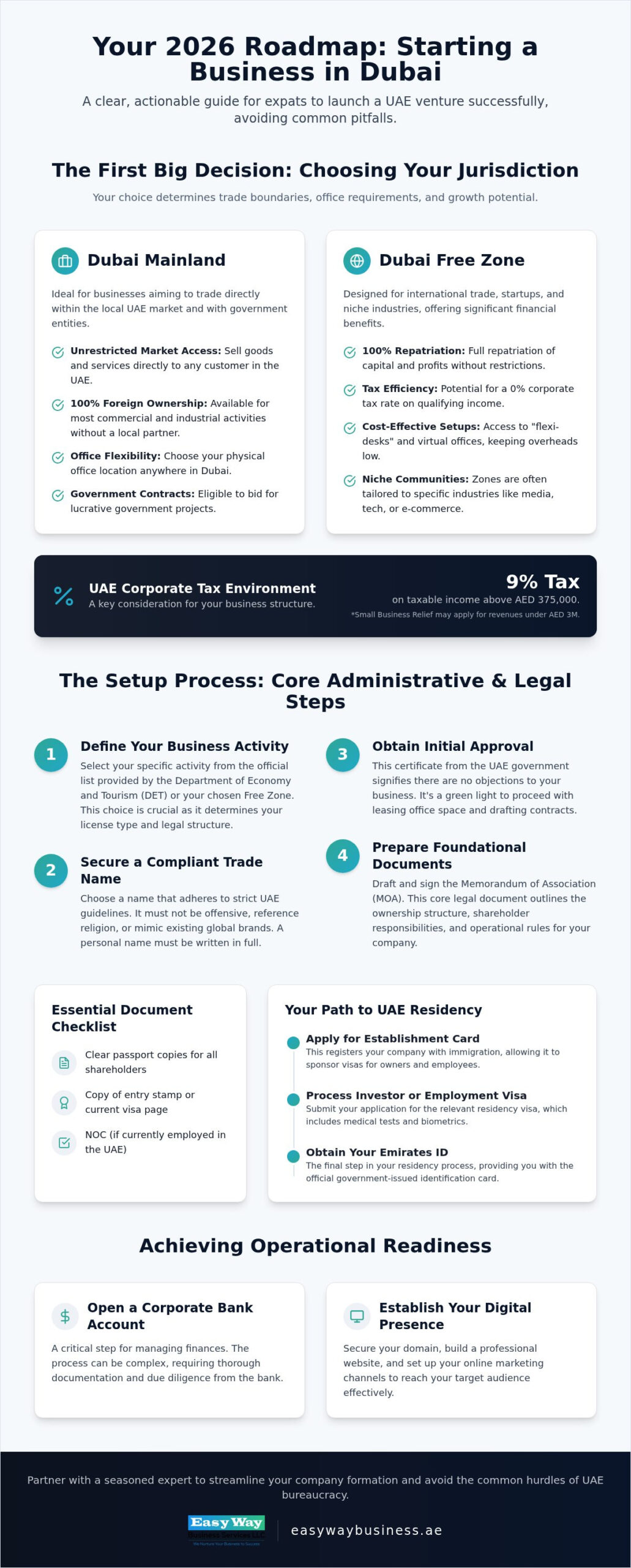
Choosing the right jurisdiction is the first major hurdle you’ll face. It determines your trade boundaries, office requirements, and long-term growth potential. While both options are attractive, they serve different strategic goals within Dubai’s Economic Landscape. Understanding the specific requirements to start a business in Dubai for expats begins with a clear look at where you want to operate. You don’t want to pick a zone that restricts your ability to reach your target customers later.
A common misconception is that you need a local partner to own a mainland company. This changed recently. Many commercial and industrial activities now allow 100% foreign ownership on the mainland. This shift has leveled the playing field between jurisdictions. However, your decision should also consider the 2026 tax environment. The UAE currently applies a 9% corporate tax on taxable income above AED 375,000. Small businesses with revenues under AED 3 million may qualify for relief, so your jurisdiction choice can impact your reporting obligations.
The Benefits of Dubai Free Zones
Free Zones are designed for international trade and specific niches. One of the biggest draws is the ability to enjoy 100% capital and profit repatriation. You own everything, and you can move your earnings back home without restriction. Tax efficiencies are also a major factor. For qualifying income, Free Zones can offer a 0% corporate tax rate. If you’re in the creative or digital space, Shams Free Zone is an excellent option for e-commerce and media startups. These zones often provide “flexi-desks” or virtual offices, which keep costs low for solo entrepreneurs.
When to Choose Dubai Mainland
If your business plan involves selling goods or services directly to local UAE residents, the mainland is your best bet. You won’t need a distributor or agent to reach the domestic market. Another advantage is the freedom to choose your office location anywhere in the city. You aren’t restricted to a specific zone. For those launching service-based businesses, exploring mainland company formation provides the most flexibility for local expansion. Mainland licenses usually require a physical office space with a verified lease, which is a crucial part of the requirements to start a business in Dubai for expats if you plan to hire a larger team.
Think about your geographic scope. Do you intend to trade locally or internationally? If you need to bid for government contracts or work with other mainland companies without restrictions, the mainland is the logical choice. If you’re a freelancer or an e-commerce brand focused on global shipping, a Free Zone setup offers a faster, more cost-effective entry point. We’ve helped thousands of companies weigh these options to ensure they don’t get stuck in the wrong legal structure.
Core Administrative Requirements: Documents and Legal Steps
Once you’ve chosen your jurisdiction, the next phase involves translating your vision into a legal entity. This is where the specific requirements to start a business in Dubai for expats become highly technical. You’ll first need to identify your business activity from the official list provided by the Department of Economy and Tourism (DET) or your chosen Free Zone. Selecting the right activity is vital because it determines your license type and the legal forms your business can take. If you choose an activity that doesn’t perfectly match your operations, you could face compliance issues later.
Choosing a trade name is your next step. The UAE has strict guidelines; your name cannot be offensive, reference religious entities, or mimic existing global brands. If you’re using your own name, it must be used in full without abbreviations. Following this, you’ll apply for “Initial Approval.” This document signifies that the UAE government has no objection to you starting your business and allows you to proceed with the next legal steps, such as signing a lease or drafting contracts.
Essential Documentation Checklist for Expats
Gathering your documents early prevents avoidable delays. For most setups, you’ll need:
- Clear passport copies for all shareholders and managers.
- A copy of your entry stamp or current visa; tourist visas are typically accepted for the initial setup.
- A No Objection Certificate (NOC) if you’re currently employed in the UAE and starting a side venture.
The Memorandum of Association (MOA) serves as the core constitutional document of your UAE company, outlining the ownership structure and operational rules. For mainland companies without multiple shareholders, you might instead draft a Local Service Agent agreement.
Professional and PRO Services
Many expats underestimate the complexity of document legalization and “PRO” (Public Relations Officer) tasks. If your documents originate outside the UAE, they often require attestation from your home country’s foreign office and the UAE Embassy. The official UAE business setup process also mandates that legal documents be translated into Arabic by certified translators before they are submitted to government portals.
These administrative hurdles are why many entrepreneurs choose to work with a partner. At EasyWay, we handle the government liaison and PRO services to ensure your filings are accurate and timely. This reduces your administrative burden so you can focus on your launch strategy. If you’re feeling unsure about the paperwork, you can reach out to our team for a personalized document review to ensure you meet all requirements to start a business in Dubai for expats.
The UAE Expat Residency Path: Visa and Emirates ID
Getting your trade license is a massive milestone, but it’s only half the battle. To actually live and work here, you must bridge the gap between your company and the immigration authorities. This is a critical part of the requirements to start a business in Dubai for expats that often catches newcomers off guard. Your business license gives you the right to trade, but your residency visa gives you the right to stay.
Your first step is applying for an Establishment Card, often called an Immigration Card. This document registers your company with the General Directorate of Residency and Foreigners Affairs (GDRFA). Without it, your business cannot sponsor any visas, including your own. Once this card is issued, you can begin the entry permit process. This permit allows you to enter the country (or change your status if you’re already here) to complete your residency formalities.
Investor Visa vs. Employment Visa
If you’re the business owner, you’ll typically apply for an Investor Visa. These are usually valid for two years and allow you to reside in the UAE as a shareholder. One major benefit is the ability to sponsor your family members or domestic staff, provided you meet the minimum salary and housing requirements. For high-level executive directors or major investors, we also provide Golden Visa assistance. This 10-year residency option offers long-term stability without the need for frequent renewals, though eligibility depends on specific investment thresholds or professional criteria.
Physical Requirements for Residency
You must be physically present in the UAE to complete your residency. This involves a mandatory medical fitness test, which includes a blood test and X-ray, and a visit to a center for biometrics like fingerprints. These steps are essential for issuing your Emirates ID. This card is your primary identification for everything from opening a personal bank account to signing a residential lease. It’s the most important document you’ll carry as an expat.
To keep your residency active, you generally shouldn’t stay outside the UAE for more than 180 consecutive days. It’s also vital to remember that while the process is structured, all visa approvals are subject to immigration authority checks. Approvals are never guaranteed and depend on individual background checks and security clearances. Our role is to guide you through these procedures, ensuring your applications are complete and follow the latest 2026 regulations to meet the requirements to start a business in Dubai for expats with minimal friction.
Financial and Operational Readiness for Expats
Securing your license and residency visa marks the beginning of your journey, but your business isn’t truly functional until you can move money and reach customers. This stage of meeting the requirements to start a business in Dubai for expats is often the most frustrating for newcomers because it involves third-party compliance. You’ll need to transition from legal setup to financial and digital infrastructure quickly to maintain momentum.
Compliance is a major theme in the 2026 UAE business environment. You must register for Corporate Tax, which currently sits at a 0% rate for taxable income up to AED 375,000 and 9% for anything above that. If your annual turnover exceeds AED 375,000, VAT registration at the standard 5% rate becomes mandatory. Setting up these systems early prevents the heavy penalties associated with late registration, such as the AED 10,000 fine for missing corporate tax deadlines. If you’re running an e-commerce venture, you’ll also need to integrate secure payment gateways to accept international and local credit card payments.
Corporate Bank Account Assistance
Opening a corporate bank account is widely considered the most challenging part of the setup process. Banks perform rigorous “Know Your Customer” (KYC) checks, requiring a detailed business profile, proof of residency, and sometimes evidence of previous business experience. While traditional banks often require a physical office and higher minimum balances, many entrepreneurs now opt for digital business bank accounts. These platforms typically offer faster onboarding and lower maintenance fees, which is ideal for startups. It’s vital to remember that bank account approval depends entirely on the bank’s internal compliance checks; no service provider can guarantee an account will be opened.
Digital Branding and Support
Your digital presence is your handshake in the UAE market. A professional logo, a localized domain name, and a dedicated business email address are essential for building credibility with local suppliers and banks. Most entrepreneurs find that having a “com.ae” or “.ae” domain helps them rank better in local searches and builds trust with UAE-based customers. Our setup packages are designed to handle these technicalities by including domain hosting and business email setup as standard. For a deeper look at maximizing your reach, check out our guide on starting a successful online business in the UAE.
Managing these operational layers while trying to grow your brand can feel like a second full-time job. We simplify this by providing the tools and guidance you need to meet the financial requirements to start a business in Dubai for expats without the typical delays. If you’re ready to get your finances in order, talk to our bank account specialists today to discuss your specific profile and documentation needs.
Simplifying Your Journey with EasyWay Business Services
You’ve seen the roadmap. Now it’s time to take the first step toward your new venture. Starting a business in a foreign country shouldn’t feel like a gamble or a test of your patience with bureaucracy. We act as your seasoned navigator through local regulations, turning what seems like a maze into a clear, manageable process. Our team has already helped form more than 2,000 companies, so we know exactly where the shortcuts are and how to avoid the common hurdles that stall most entrepreneurs.
We pride ourselves on being an A-to-Z partner. This means we don’t just hand you a license and walk away. We provide dedicated account management to handle your documentation updates, government liaisons, and renewals. Because we work with more than 20 Free Zone authorities, we can offer unbiased advice on which jurisdiction actually fits your budget and business activity. Our multilingual team speaks more than 10 languages, ensuring that you always have a clear, direct line of communication as you fulfill the requirements to start a business in Dubai for expats.
Promotional Startup Packages
We believe in optimistic pragmatism, which is why our pricing is transparent and designed for different startup stages. Whether you’re a digital nomad or a growing team, we have a setup that works for you. Our current promotional packages include:
- E-Commerce License (0 Visa): AED 4,000 (Subject to terms and conditions).
- Freezone License (1 Visa): AED 8,500 (Subject to terms and conditions).
- Freezone License (2 Visas): AED 12,500 (Subject to terms and conditions).
Prices and government fees can change based on the specific authority or updated 2026 regulations. You should always confirm the latest quotations with an EasyWay consultant before starting your application. These packages are designed to be accessible entry points, allowing you to meet the requirements to start a business in Dubai for expats without heavy upfront costs.
Get Started with Your Tailored Recommendation
Your ideal setup depends on your specific goals, from trade boundaries to your residency needs. We’ll consult with you to determine the most effective business activity and jurisdiction for your brand. We analyze the differences between various zones to find the one that offers the best tax efficiencies and operational freedom for your specific industry. Don’t let the fear of hidden fees or overwhelming paperwork hold you back from your professional dreams.
Ready to launch? Contact EasyWay Business Services today for a personalized consultation. We’ll provide a no-nonsense roadmap tailored to your situation, ensuring your transition into the UAE business world is as smooth and efficient as possible.
Take the First Step Toward Your Dubai Success
You now have a clear roadmap to navigate the complexities of the UAE market. Understanding the requirements to start a business in Dubai for expats is the first step toward securing your autonomy and growth in a global hub. Whether you choose the local reach of the mainland or the specialized benefits of a free zone, your success depends on following a structured path from licensing to residency. Every document you file and every compliance check you meet today builds the foundation for your 2026 goals.
EasyWay Business Services is here to ensure that foundation is rock solid. We’ve formed more than 2,000 companies and act as a dedicated A-to-Z partner for all your setup and operational needs. Our multilingual team provides support in over 10 languages, so you always have clarity throughout the process. We prioritize your time and peace of mind, offering a no-nonsense approach to business formation. Start your UAE business journey with a professional consultation today. Your professional dreams are within reach, and we’re ready to help you turn them into a reality.
Frequently Asked Questions
Do I need a local partner to start a business in Dubai as an expat?
You don’t need a local partner for most business activities in Dubai. Recent regulatory changes allow 100% foreign ownership on the mainland for many commercial and industrial sectors. Free Zones have always offered full ownership to expats. This shift simplifies the requirements to start a business in Dubai for expats by removing the need for a local sponsor who owns 51% of your company. You maintain full control over your operations and profits.
How much does it cost to start a business in Dubai for a foreigner?
The cost varies significantly based on your jurisdiction and visa needs. For example, an e-commerce license with zero visas starts at AED 4,000, while a two-visa Free Zone setup is priced at AED 12,500. These figures represent promotional packages and are subject to terms and conditions. You should also budget for additional expenses like medical tests and Emirates ID fees. Always request a current quotation to account for the latest government fee updates.
Can I get a residency visa by starting a company in the UAE?
Yes, starting a company is one of the most reliable ways to secure UAE residency. Once your trade license and Establishment Card are issued, you can apply for an Investor Visa. This visa typically grants you a two-year residency period, which is renewable as long as your business remains active. It also allows you to sponsor your family members. Remember that all visa approvals depend on immigration authority checks and aren’t guaranteed.
What are the main documents required for expat business setup?
You’ll need several core documents to begin. These include clear passport copies for all shareholders, a copy of your current UAE entry stamp or visit visa, and a No Objection Certificate (NOC) if you’re currently employed in the UAE. If your documents are from outside the UAE, they may require legal attestation and Arabic translation. Having these ready early helps you meet the requirements to start a business in Dubai for expats without facing avoidable administrative delays.
Is a physical office mandatory for a new business in Dubai?
It depends on your chosen license type and jurisdiction. Many Free Zones offer “flexi-desk” or virtual office options that satisfy legal requirements without the cost of a full physical space. However, if you opt for a Dubai Mainland license, a physical office with a verified lease agreement is generally required. If you plan to hire a large team, you’ll need to ensure your office size meets the quota for the number of visas you require.
How long does the business setup process typically take for expats?
The timeline varies by authority, but you can often get a trade license in just a few working days. The residency process, including the medical test, biometrics, and Emirates ID issuance, usually takes an additional two to three weeks. Factors like document attestation from your home country or specific activity approvals can extend this timeframe. We focus on streamlining these steps to ensure your business becomes operational as quickly as possible, though approvals are never guaranteed.
Can I open a bank account if I have a Free Zone license?
Yes, you can open a corporate bank account with a Free Zone license. While some traditional banks used to prefer mainland companies, the rise of digital business banking has made it easier for Free Zone startups to get onboarded. You’ll need to provide your license, MOA, and proof of residency for KYC checks. Approval isn’t guaranteed and depends entirely on the bank’s internal compliance policies and your specific business profile.
What is the difference between an Investor Visa and a Freelance Visa?
An Investor Visa is for business owners who hold shares in a UAE company, offering a path to sponsor employees and family. A Freelance Visa is a permit for individuals to work as independent contractors in specific sectors like media or education. Investor Visas generally provide more flexibility for scaling a team and managing a corporate entity. Both options require you to maintain valid health insurance and follow specific renewal procedures to stay compliant.